
Introduction
There are tons of real estate website templates out there. If you've spent any time browsing template marketplaces, you know how overwhelming it gets. Hundreds of options, each claiming to be perfect for your needs, and you're left more confused than when you started. That's exactly why we've done the heavy lifting for you.
Start With Your Brand Strategy First
Before you even think about choosing a template, you first need to do create your brand strategy and identity. This might sound like extra work, but it's going to save you countless hours of second-guessing later. You don't need a full comprehensive brand strategy, but at least you should have the basics when you're getting started.
When you have a clear brand strategy, you'll know exactly what you're looking for in a template. Your color palette, your tone, your target audience, whether you're going after luxury listings or first-time homebuyers.
All of these decisions become crystal clear once your brand foundation is solid. Skip this step, and you'll find yourself changing templates every few months because nothing feels quite right.
Choose Your Website Builder Next
After nailing down your brand identity, you need to pick the right website builder. Not all platforms are created equal, and your choice here will determine how much flexibility you have with customization.
This matters more than you might think. Some builders lock you into rigid structures that make every site look identical. Others give you the freedom to truly make a template your own.
How We Chose These Templates
We didn't just scroll through a marketplace and pick templates that looked pretty. Our selection process was built on years of experience and understanding what actually works.
We spent countless hours researching dozens of templates and evaluating their effectiveness for real estate businesses. The templates you'll see below are handpicked because they work. They're designed specifically for real estate.
One quick note: some of these templates might have placeholder text and content that doesn't make perfect sense, some of them even have really cringy headlines and images. Don't worry about that. We're focusing on the design structure and functionality. You can customize all the content later to match your brand.
Why We Chose Webflow Templates
All the templates we're recommending are built on Webflow.
Here's why that matters.
Webflow gives you incredible flexibility to customize any template and make it uniquely yours. Unlike other website builders that lock you into a rigid structure, Webflow lets you adjust virtually everything.
This means even if you start with a template, your site won't look like an exact replica of everyone else using the same one.
That level of customization is crucial for standing out in real estate.
An Important Note About Property Listings
Since we're talking about templates with property listing features, here's something important for North American agents and brokerages.
You can use Webflow's CMS (or any content management system) to upload your own listings without using IDX. And no, this doesn't violate MLS or IDX rules, as long as you're only displaying your own listings and not pulling MLS data from other brokers.
The MLS and IDX rules specifically govern MLS-provided listing data, not your own marketing content. This gives you more control over how you present your properties online.
The Best Real Estate Website Templates
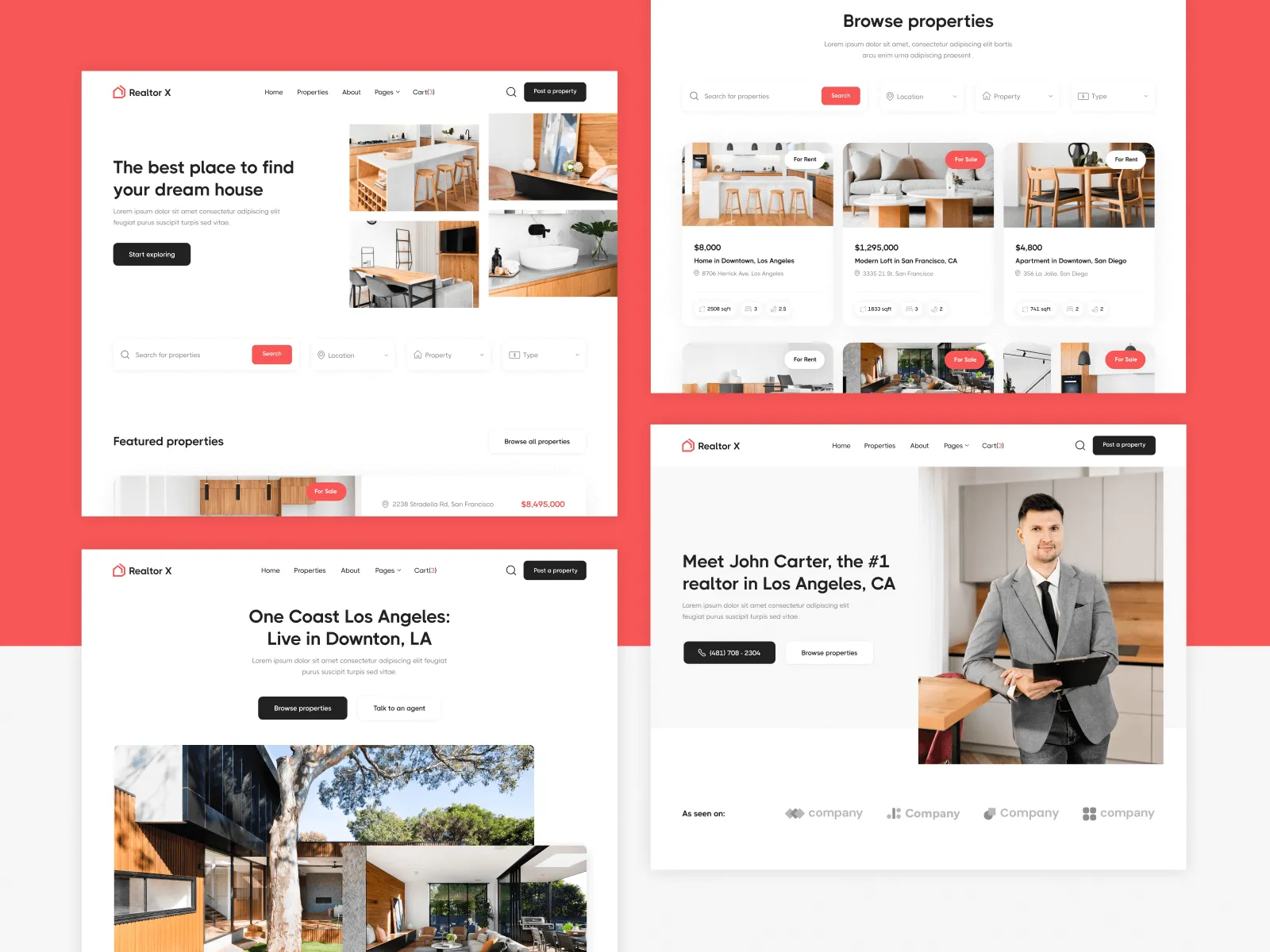
1. Realtor X
Realtor X brings a very modern aesthetic that works whether you're a solo agent or running a full brokerage. What sets it apart is the thoughtful structure: three different homepage versions (including one specifically designed for solo agents), giving you flexibility right out of the box.
The property listing detail pages are exceptionally well-designed with embedded agent contact forms, making it easy for potential clients to reach out while they're viewing a property. You'll also get dedicated pages for property locations and types, which are excellent for SEO. With 35 pages and over 60 sections to customize, you have plenty of room to make this template work for your specific needs.
The agent profile pages add authenticity and help build credibility with potential clients. Plus, the built-in blogging features mean you can create local SEO content without needing additional tools.
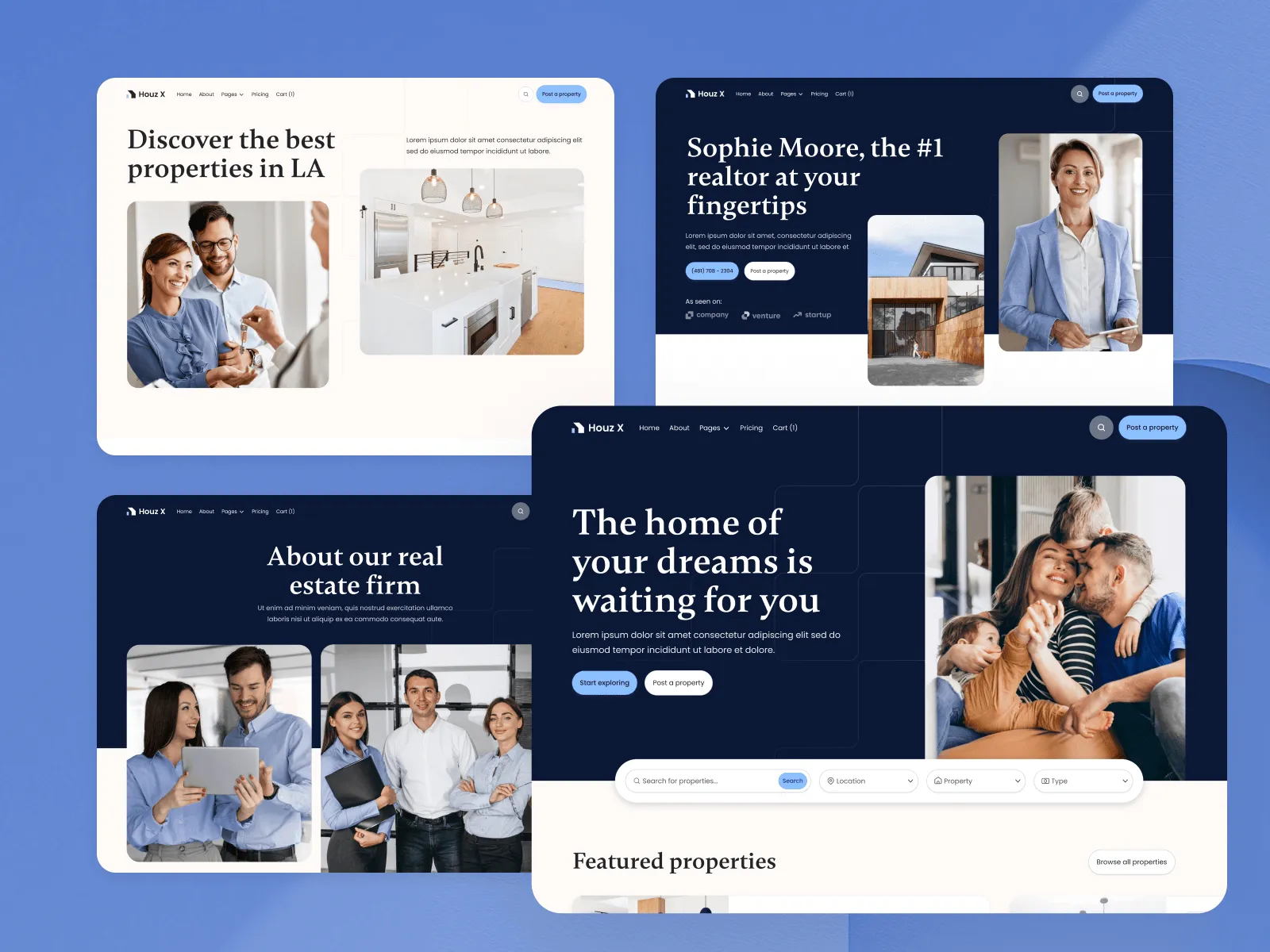
2. Houz X
Built by the same team behind Realtor X, Houz X shares many of the same features but with a slightly more elegant design approach. If you're looking for something that feels a bit more refined while maintaining functionality, this is worth considering.
You get 25+ pages and 75+ sections to work with. Like its sibling template, it includes three homepage variations (one for solo agents), property location pages, property type pages, and those same well-designed listing detail pages with embedded agent forms.
The agent profile pages and blogging capabilities are included here too, giving you everything you need to build authority and improve your local search visibility.
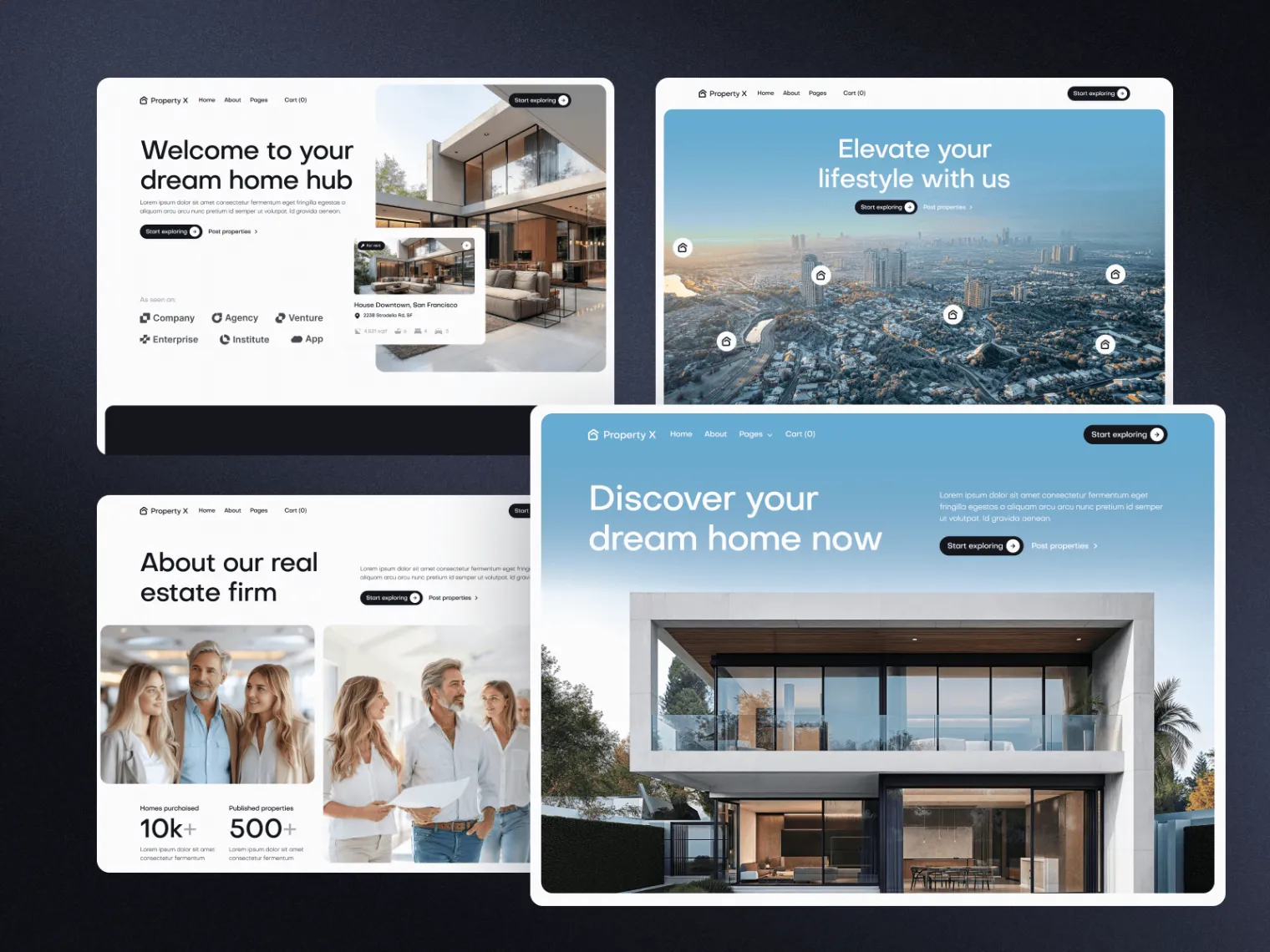
3. Property X
Property X takes a different visual approach that really makes it stand out. The way the hero images and text are embedded together creates a more dynamic, less cookie-cutter feel. You get three different homepage variations, each with its own personality.
At 26 pages with 40+ sections, it's slightly smaller than the previous two templates, but it doesn't sacrifice functionality. You still get all the essential features: property location pages for SEO, property type pages, beautifully designed listing detail pages with embedded forms, and agent profile pages.
The three contact page versions are particularly useful because you can tailor each one for different conversion goals. And yes, blogging features are built in for your local SEO content strategy.
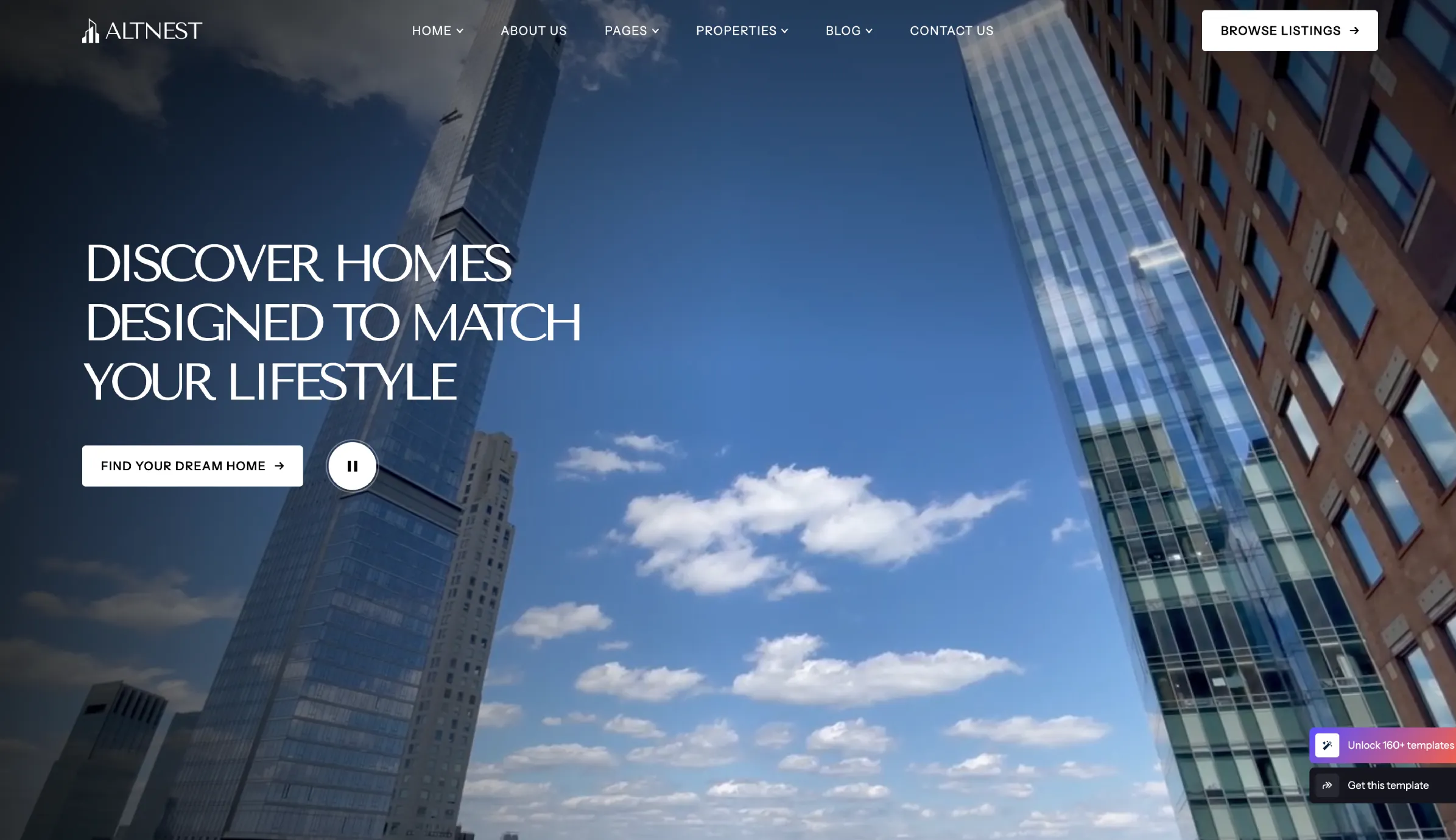
4. Altnest
If you're in the luxury real estate market, Altnest is designed specifically with you in mind. The elegant, premium design immediately communicates high-end quality, which is exactly what luxury property buyers expect.
With 12 unique pages and 50+ sections, it's more focused than some of the other templates, but that's intentional. You get three homepage variations, and two of them support video in the hero section. Video content can significantly improve conversion rates, especially when you're showcasing stunning luxury properties.
The property detail pages have a unique layout that you won't find on most listing sites. It's thoughtfully designed for the luxury market. You also get three variations of property filtering pages, location pages for SEO, and both team overview and individual agent pages to build trust with high-end buyers.
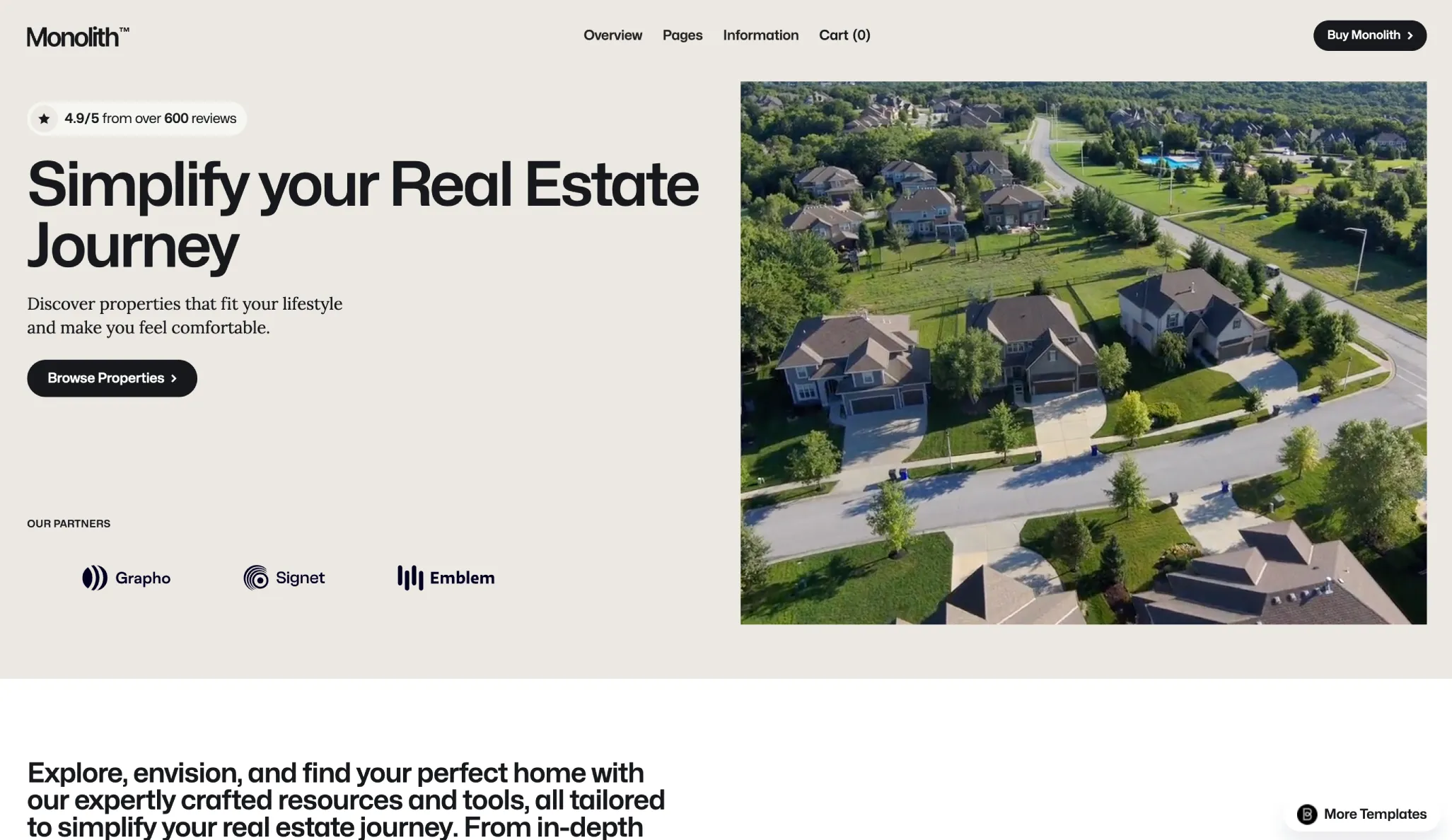
5. Monolith Estate
Monolith Estate offers a clean, minimalistic design that strikes a nice balance between modern and elegant. It's versatile enough for any type of real estate business, and the sitemap structure is simpler compared to other templates we've mentioned.
This template doesn't come with built-in location pages, but here's the thing: you can easily modify and duplicate the property filtering pages to target multiple locations for SEO. It requires a bit more upfront work, but Webflow makes it straightforward.
The about page showcases your team nicely, though it doesn't include individual pages for each team member out of the box. Again, this is easy to add in Webflow if you need it. Similarly, there aren't property filtering pages by property type included, but the platform gives you full capability to create them.
If you want something clean and simple without a lot of complex features to manage, Monolith Estate is a solid choice.
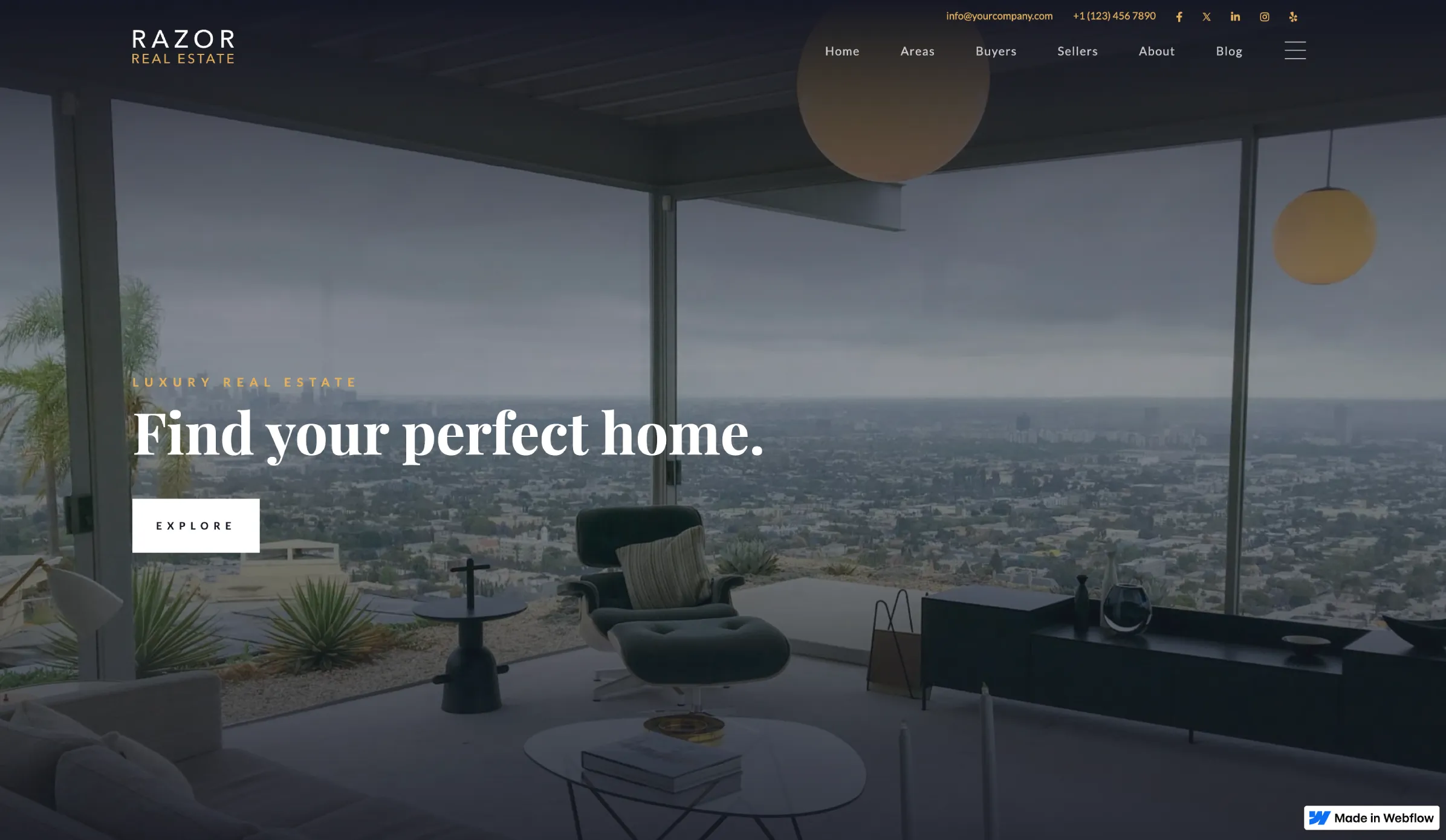
6. Razor
Razor is the most comprehensive and complex template on this list. It's designed for luxury-oriented real estate businesses, particularly larger, more established brokerages.
Beyond the standard location and area pages, Razor includes dedicated sub-pages for buyers and sellers: selling your home, valuation pages, exclusive listings, and more. This is perfect if you want to provide detailed resources and information to different audience segments.
The template also includes multiple pages about your company: your story, testimonials, corporate leadership, team pages, and more. This level of detail is ideal for larger brokerages that need to communicate their history, values, and expertise.
One note: the property detail pages aren't quite as detailed as some other templates here. They have an unconventional layout that's likely tailored for the luxury audience, and while the design is decent overall, it's not the strongest feature of this template.
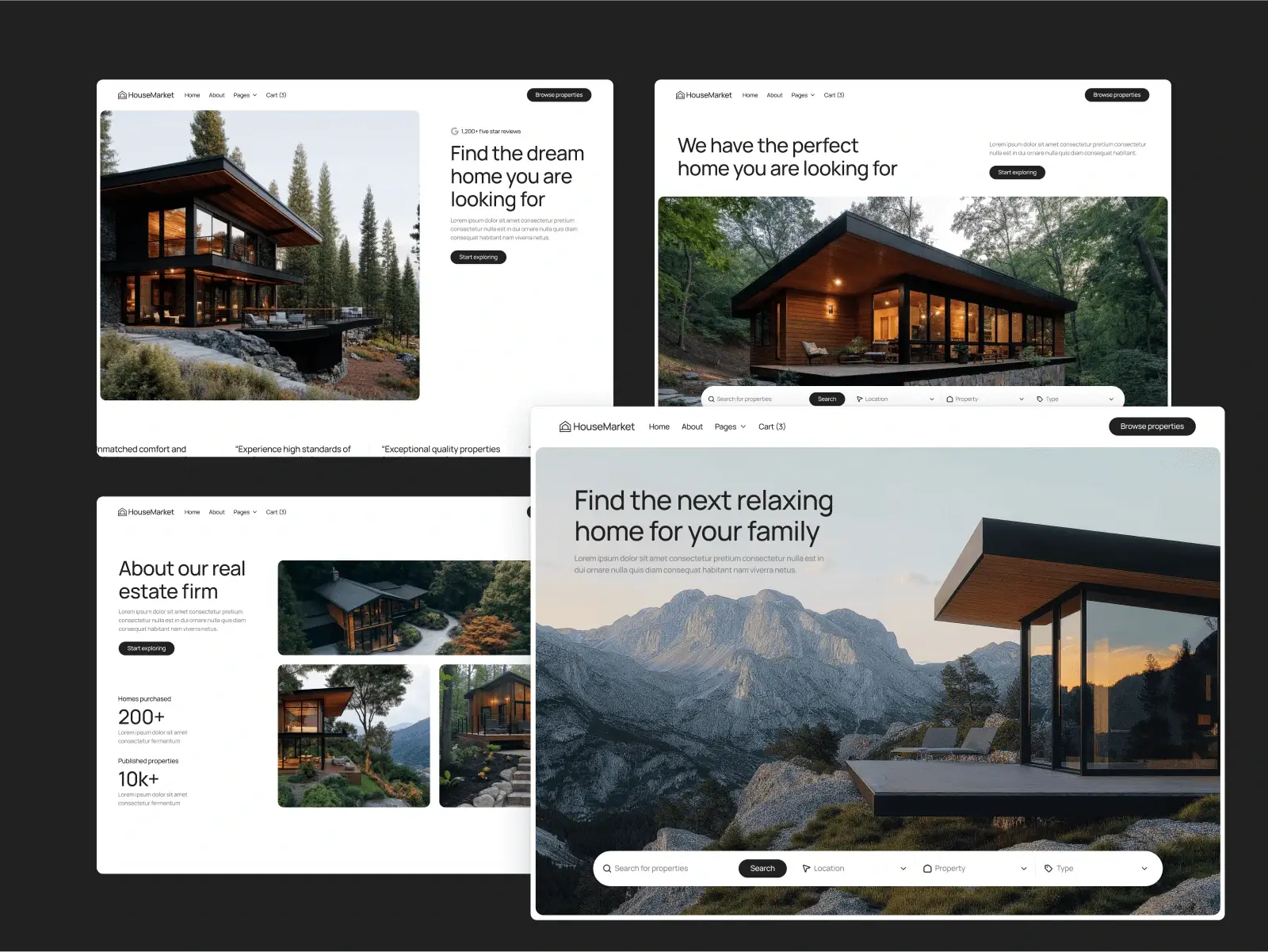
7. HouseMarket
HouseMarket follows a similar design aesthetic to Realtor X, Houz X, and Property X (it's built by the same company). There's nothing drastically different here, just a slightly alternative design approach.
With 24 pages and 44 sections, you get property location pages for SEO, property type pages, agent pages, and blogging features for local SEO content.
Honestly, we prefer the other templates from this company, but we're including HouseMarket here to give you more options. Sometimes it comes down to personal preference, and you might connect with this design more than the others.
Our Top Recommendations
All of these templates are handpicked and well-made, but let's narrow things down based on your specific situation.
- If you want the most simple and clean design, go with Monolith Estate. Yes, the other templates aren't overly complicated either, but Monolith has less initial setup work and a more streamlined structure.
- If you want versatile templates that work for almost any real estate business, we recommend Realtor X, Houz X, Property X, and maybe HouseMarket. These give you the most flexibility and features out of the box. HouseMarket ranks lowest on our list, but it's still a solid option if the design speaks to you.
- If you're focused exclusively on luxury listings, go with Altnest or Razor. We prefer Altnest for most luxury businesses. Razor is better suited for much larger brokerages with more complex needs, but it requires significantly more work to set up properly.
You'll Probably Need Expert Help
Since these templates are built on Webflow, an advanced platform with lots of customization options, you'll likely need a real estate website expert to set them up properly and do the necessary customization work to fit your brand.
Before you worry about the cost, consider this: it's still significantly cheaper than hiring a web designer to build a site from scratch. And if you try to do it yourself without experience, these templates can easily break if something isn't done correctly. An expert ensures everything is set up right from the start.
Once everything is properly configured, you can edit and update your website without requiring a developer for every little change. This is a huge cost-saving benefit compared to other website builders that require ongoing developer work for updates, where one wrong move can break your entire site.
Freqently Asked Questions
How long does it typically take to customize and launch a site with one of these templates?
It depends on how much customization your site needs. Since these are Webflow templates, you'll likely want to hire an expert to handle the setup and customization. For most projects, expect anywhere from one to several weeks. More complex sites with extensive customization will naturally take longer.
Can I integrate my CRM or email marketing tools with these templates?
Yes, you can integrate virtually any third-party tool. Most integrations work through custom code or automation platforms like Zapier, making it easy to connect your existing marketing stack.
Do these templates work well on mobile devices?
Absolutely. All of these templates are fully mobile-responsive. In 2026, this isn't even a question anymore. It's simply the standard, and these templates deliver on that expectation.
How do I optimize these templates for local SEO in my specific market?
You have two options: use the existing location pages that come with most templates, or build your own using the pre-built sections. We're big fans of creating detailed neighborhood pages that include information about the area along with relevant property listings. This approach works exceptionally well for local SEO.
Will these templates hurt my SEO if other agents are using the same one?
No. Search engines don't evaluate design when ranking your site. They look at your content quality, relevance, and how users engage with your site. Using the same template as another agent won't hurt your rankings. What matters is having unique, valuable content that serves your audience.
How do I make sure my site doesn't look like everyone else's?
These templates come with numerous pre-built sections and components, giving you countless design combinations to choose from.
Mix and match these elements to create a unique look. More importantly, focus on creating original content that reflects your brand voice and serves your specific market. Unique content matters just as much as unique design.
Can I integrate MLS/IDX feeds if I want to later?
Yes, you can integrate any IDX platform you choose. However, we only recommend this if you're a large brokerage with significant website traffic. For solo agents and small brokerages, stick with the template's built-in property database system This gives you much better control over your listing design and content without the complexity of IDX.
Important note: Due to regulations, If you're not using IDX, you can only show your own listings and you must also own the content of those listings (images, etc.).
Can I add a mortgage calculator to these templates?
Yes, but you'll need to add custom code, which means hiring a web developer to set it up for you.
Can I password-protect certain listings or pages?
Yes, Webflow allows you to password-protect specific pages. This is perfect for exclusive listings, off-market properties, or client-only content.

We partner with real estate brands across North America to develop and execute strategic marketing solutions that attract buyers, sellers, and investors.