


Introduction
You've seen it happen. An agent in your area closes deal after deal while you're still hustling for every lead. Another agent commands premium commissions while you're justifying your rates.
What's their secret?
More often than not, it comes down to branding.
A strong real estate branding strategy sets you apart in a crowded market. It makes clients remember you, trust you, and choose you over the competition. While other agents blend together, your brand makes you the obvious choice for the clients you actually want to work with.
This guide walks you through building a real estate brand from the ground up. You'll learn how to identify your target client, define what makes you different, create a visual identity that resonates, and bring it all together into a cohesive strategy that drives real business results.
What is Real Estate Branding
Real estate branding is how you present yourself to the market. It's the unique combination of your values, personality, visual identity, and client experience that makes you recognizable and memorable.
Your brand includes everything from your logo and color scheme to how you answer the phone and follow up after a showing. It's the promise you make to clients and the experience you consistently deliver.
Think of branding as your professional identity. Just as people know you for certain traits in your personal life, your brand represents what you stand for in business.
Why Real Estate Branding Is Important
In real estate, you're competing with hundreds or thousands of other agents. Most offer similar services at similar prices. Without a strong brand, you're just another name on a business card.
Branding creates differentiation.
When you have a clear brand identity, clients understand what makes you different and why they should work with you instead of someone else.
Branding builds trust faster.
People prefer working with agents who seem established and professional. Strong branding signals that you're serious about your business and capable of handling their transaction.
Branding attracts the right clients.
When your messaging speaks directly to first-time buyers, you'll naturally attract more of them. When your visual identity screams luxury, high-end sellers will gravitate toward you. Your brand filters out the wrong clients while drawing in the perfect ones.
How To Create A Real Estate Brand
Building your brand requires a strategic approach. You can't just pick colors you like and call it branding.
Instead, you'll work through a series of steps that create a cohesive, authentic identity aligned with your business goals.

1. Identify Your Target Client
The foundation of effective branding is knowing exactly who you're trying to reach.
Many agents make the mistake of targeting "everyone." If you're trying to appeal to first-time buyers and luxury sellers and investors and downsizers all at once, your message becomes generic and appeals to no one.
Choose a specific client type to focus on. Your options include:
- First-time homebuyers
- Luxury sellers
- Real estate investors
- Downsizers
- Military families
- Relocating professionals
- Commercial buyers
- Vacation property seekers
Ask yourself these questions to identify your ideal client:
- What's their budget range? Are you working with $200,000 starter homes or $2 million estates?
- What problems do they face? First-time buyers need education. Luxury clients want discretion and white-glove service. Investors need market data and ROI analysis.
- What do they value most? Some clients prioritize speed, others want hand-holding throughout the process. Some value local expertise while others care more about negotiation skills.
- Where are they located? Are you focusing on a specific neighborhood, city, or region?
- What are their goals? Understanding whether they're buying their forever home, making an investment, or planning a quick flip shapes how you position your services.
- What are their fears? What keeps them up at night about buying or selling? Addressing these fears in your branding builds immediate connection.
The clearer this picture, the easier it becomes to craft messaging and visuals that resonate.

2. Define Your Brand
This step represents the heart of your real estate branding strategy. It's where you define who you are and what you stand for as a professional.
Your brand foundation shapes everything else that follows, from your visual identity to your client experience.
This requires honest self-reflection, but it creates authentic differentiation that competitors can't copy.
Brand Story
Your brand story explains why you're in real estate and why clients should care.
This isn't your resume or a list of credentials. Your story creates connection by revealing your motivation and values.
Use this simple structure to craft your story:
- What got you into real estate? Maybe you had a terrible experience buying your first home and wanted to do better for others. Perhaps you grew up in a family of builders and developed a passion for properties. Or you switched careers after realizing you loved helping people make major life decisions.
- What problem do you solve? Connect your background to the specific challenges your target clients face.
- Why does it matter to you? Share the personal reason this work resonates beyond just making a living.
Here are examples of effective brand stories:
- "I became a real estate agent after watching my parents struggle to downsize from our family home. The agent they worked with rushed them through decisions and didn't understand the emotional weight of leaving a place filled with memories. Now I specialize in helping empty nesters transition to their next chapter with patience, care, and practical guidance that honors both the practical and emotional sides of selling."
- "My background is in commercial construction, but I kept meeting first-time buyers who felt intimidated by the process and overwhelmed by industry jargon. I switched to residential real estate to be the agent I wish these buyers had from the start. I translate complex concepts into plain language and make sure my clients understand every step before we move forward."
- "After relocating five times in ten years for my spouse's military career, I learned firsthand how stressful it is to buy a home in an unfamiliar city while juggling deployments and tight timelines. Now I work exclusively with military families, using my experience to smooth out the process and advocate for buyers who might be managing the purchase from across the country."
Keep your story authentic and relatable. Three to five paragraphs work well.
This story becomes your "About" content on your website and a natural conversation starter when meeting new clients.
Define Your Brand Mission
Your mission statement describes what you do and who you serve right now. It's your current purpose, not a future aspiration.
Keep your mission simple and free of industry jargon. Use this formula:
"To [action] for [target client] by [how you do it]"
Here are real estate examples:
- "To guide first-time homebuyers through the purchase process by providing education, transparency, and patient support at every step."
- "To deliver exceptional results for luxury property sellers by combining high-end marketing, discretion, and expert negotiation."
- "To help investors build wealth through real estate by identifying undervalued properties and providing data-driven market analysis."
Your mission should be one to two sentences maximum. This statement guides your day-to-day decisions and keeps you focused when opportunities arise that don't align with your core business.
Define Your Brand Vision
While your mission describes where you are now, your vision describes where you want your business to be in the future. This is your long-term aspiration.
Ask yourself these questions:
- What impact do you want to make? Do you want to change how people experience buying homes in your area?
- What do you want to be known for? In five years, what should people immediately think of when they hear your name?
- Where do you see yourself? Are you building a team? Becoming the top agent in a specific neighborhood? Opening your own brokerage?
Here are vision statement examples:
- "To become the most trusted name in sustainable and eco-friendly homes in Portland, known for connecting environmentally conscious buyers with properties that match their values."
- "To build a team of buyer specialists who collectively help 200+ first-time buyers achieve homeownership each year while maintaining a 100% client satisfaction rate."
- "To transform how luxury properties are marketed in the region by setting new standards for photography, staging, and digital presentation."
Your vision should be inspiring but realistic. One to two sentences work best.
This statement keeps you motivated during challenging times and guides decisions about growth and expansion.
Define Your Brand Values
Brand values are the principles that guide how you conduct business. These should reflect your actual behavior, not aspirational wishes.
Choose three to five core values that truly matter to you. Here are examples of values common in real estate:
- Integrity means you tell clients the truth even when it costs you a sale.
- Transparency means you explain every step of the process and never hide information.
- Community focus means you invest time and resources in the neighborhoods you serve.
- Innovation means you embrace new technology and methods to serve clients better.
- Client education means you prioritize helping clients understand their options over pushing them toward quick decisions.
- Results-driven means you focus relentlessly on achieving the outcomes clients hired you to deliver.
Connect your values to what your target clients care about. If you work with first-time buyers, values like patience, education, and transparency resonate. For luxury clients, discretion, excellence, and attention to detail matter more.
Write Your Unique Value Statement
Your unique value statement distills what makes you different into one clear sentence.
Use this formula: "I help [target client] achieve [specific outcome] through [your approach/difference]"
Examples:
- "I help first-time homebuyers navigate the purchase process with confidence through personalized education and step-by-step guidance."
- "I help luxury homeowners achieve top-dollar sales through sophisticated marketing and access to an exclusive network of qualified buyers."
- "I help real estate investors maximize returns through detailed market analysis and identification of undervalued properties before they hit the MLS."
This becomes the foundation of all your messaging. Keep it to one or two sentences.
You'll use variations of this statement across your website, social media, email signature, and conversations with potential clients.
Define Your Brand Personality
Brand personality describes how your brand acts and sounds. This shapes your tone, imagery, and design choices.
Consider these personality types relevant to real estate:
- Professional/Corporate: Polished, formal, business-focused. Works well for commercial real estate or corporate relocation services.
- Friendly/Approachable: Warm, conversational, down-to-earth. Ideal for first-time buyers or family-focused agents.
- Luxury/Sophisticated: Elegant, refined, exclusive. Perfect for high-end residential properties.
- Innovative/Modern: Tech-savvy, forward-thinking, cutting-edge. Appeals to younger buyers or those interested in smart homes.
- Local/Community-Focused: Neighborly, connected, invested in the area. Great for neighborhood specialists.
- Expert/Educator: Knowledgeable, informative, helpful. Works for agents who position themselves as market experts or buyer educators.
Choose two to three traits that fit both your target client and your natural style. If you're genuinely introverted and formal, forcing a bubbly, casual brand personality will feel inauthentic and exhausting to maintain.
Your brand personality influences everything from the photos you choose to the words you use in emails. A luxury brand might describe a home as "a masterfully crafted residence," while a friendly brand would call it "a beautiful home perfect for your family."
Define Your Brand Voice
Brand voice describes how you communicate in writing and speaking.
Consider where you fall on these spectrums:
- Formal vs. Casual: Do you address clients as "Mr. and Mrs. Johnson" or "Hey, Sarah and Tom"?
- Serious vs. Playful: Are your communications straightforward and professional, or do you include humor and personality?
- Authoritative vs. Collaborative: Do you position yourself as the expert who guides clients, or as a partner who works alongside them?
Your voice should match your personality and appeal to your target client.
First-time buyers often prefer a more casual, collaborative voice that makes them feel comfortable asking questions. Luxury clients might expect a more formal, authoritative tone that signals sophistication and expertise.
Document specific examples of your voice in action. Write out how you'd phrase common communications like email subject lines, text message check-ins, or social media captions. This creates consistency across all your client touchpoints.
Choose A Brand Name
Your brand name is often one of the first decisions you made when starting your business, but if you're rebranding or just starting out, consider these options:
Personal name
Example: Sarah Johnson Real Estate
This builds personal recognition and works well if you plan to be the face of your business long-term.
- Pros: Easy to remember, builds personal brand, can't be replicated
- Cons: Harder to sell the business later, limits team growth, everything ties to you personally
Descriptive name
Example: Coastal Properties Group, First Home Partners
- Pros: Immediately communicates what you do, helps with SEO, makes niche clear
- Cons: Can be limiting if you expand, may sound generic, harder to trademark
Creative/Unique name:
Example: Keystone Realty, Elevation Partners
- Pros: Distinctive and memorable, allows for growth and evolution, easier to trademark
- Cons: Requires more marketing to establish meaning, might confuse potential clients initially
Practical considerations for any name:
- Easy to spell and pronounce (if people can't spell it, they can't search for you online)
- Not too limiting (avoid names tied to specific neighborhoods if you might expand)
- Available domain (check if domain name is available in .com before committing)
If you're already established with a name, focus on strengthening the other elements of your brand rather than starting over with a name change.
3. Build Your Visual Identity
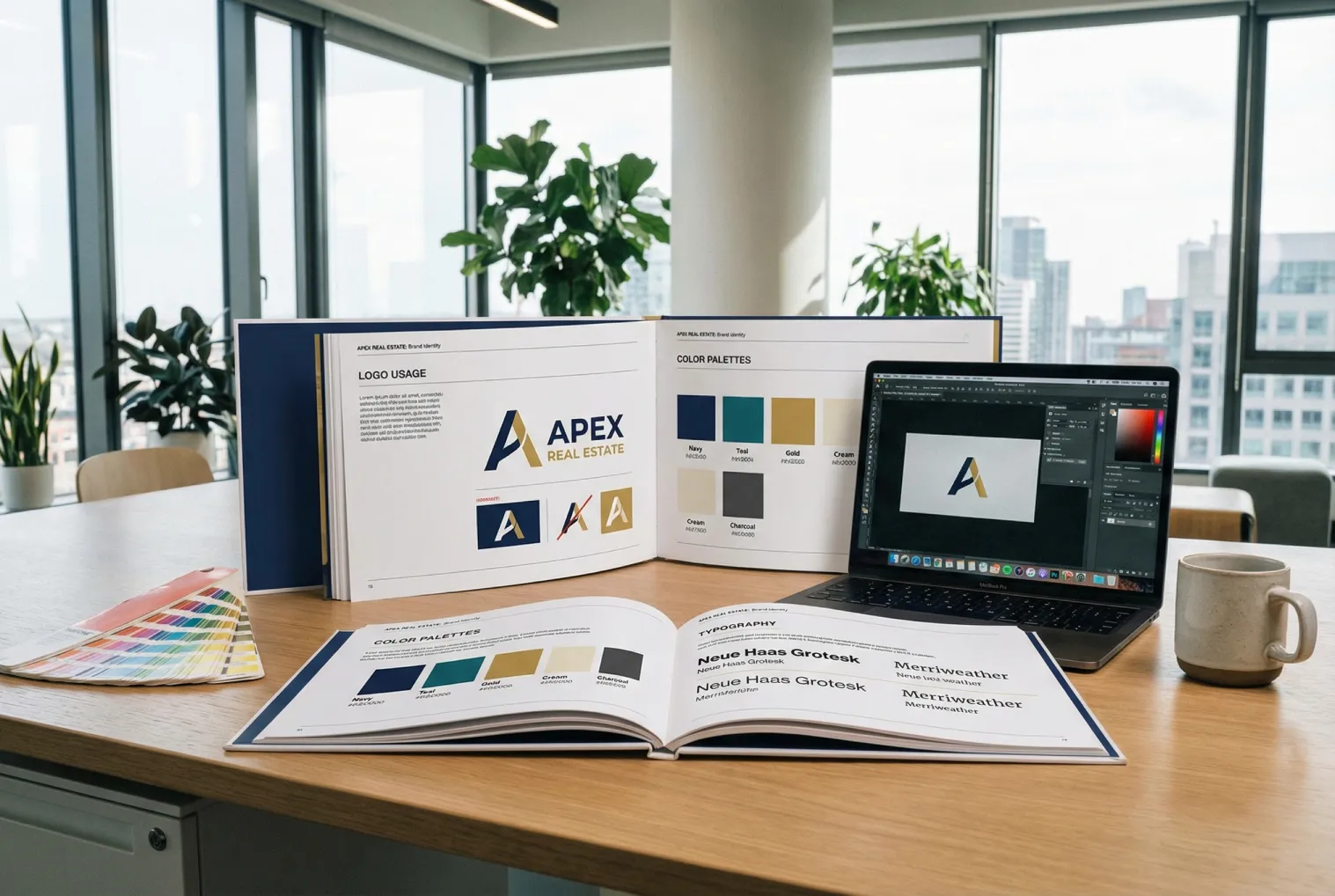
Your visual identity includes the colors, fonts, and style that people will associate with your brand. These elements should match your personality and appeal to your target client.
Choose Brand Colors
Color psychology plays a significant role in how people perceive your brand. Different colors evoke different emotional responses:
- Blue suggests trust, stability, and professionalism (the most popular choice in real estate for good reason)
- Green represents growth, harmony, and prosperity (works well for sustainable properties or new construction)
- Black conveys luxury, sophistication, and exclusivity (perfect for high-end residential or commercial)
- Gray signals professionalism and neutrality (often paired with accent colors for a modern look)
- Gold represents success, quality, and prestige (common in luxury branding)
- Red creates urgency and excitement (use sparingly as an accent color)
Choose two to three primary colors that fit your personality and audience.
A luxury agent might use black, gold, and cream. A friendly neighborhood specialist might choose warm blue, green, and white. An innovative modern agent could pick charcoal gray, electric blue, and white.
Your colors appear on business cards, yard signs, website, social media graphics, and all marketing materials. Consistency matters.
Helpful tools for finding color combinations:
- Coolors
- Adobe Color
- Canva's color palette generator
Select Your Fonts
Keep your font selection simple. Choose one main font and possibly one accent font.
- Serif fonts (like Times New Roman or Garamond) feel traditional, trustworthy, and established. They work well for luxury brands or agents emphasizing experience and stability.
- Sans-serif fonts (like Arial, Helvetica, or Montserrat) appear modern, clean, and approachable. They're ideal for contemporary brands or agents targeting younger clients.
- Script fonts (like Great Vibes or Pacifico) convey elegance and personality. Use them sparingly for logos or headlines, never for body text.
Match your fonts to your brand personality. Here are pairing examples:
- Luxury/Traditional: Playfair Display (serif headline) + Lato (sans-serif body)
- Modern/Clean: Montserrat (sans-serif headline) + Open Sans (sans-serif body)
- Friendly/Approachable: Poppins (rounded sans-serif headline) + Roboto (sans-serif body)
- Sophisticated/Elegant: Cormorant (serif headline) + Raleway (sans-serif body)
Find free professional fonts on Google Fonts or DaFont. Once you choose your fonts, use them consistently across all materials.
Determine Your Visual Style
Visual style describes the look and feel of images, graphics, and layouts you use. Your style should align with your personality and resonate with your target client.
- Photography-heavy emphasizes high-quality property photos and lifestyle imagery. Works well for luxury agents or those in visually stunning markets.
- Minimalist uses clean layouts with lots of white space and simple graphics. Appeals to modern, design-conscious clients.
- Bold/Graphic features strong colors, geometric shapes, and eye-catching designs. Good for agents wanting to stand out in competitive markets.
- Warm/Inviting incorporates soft colors, friendly imagery, and approachable layouts. Perfect for family-focused or first-time buyer specialists.
- Sleek/Modern showcases crisp lines, contemporary photography, and tech-forward aesthetic. Attracts younger buyers or clients interested in modern properties.
Look at brands you admire in and outside real estate. Save examples that resonate with you. Identify common threads in the imagery and layouts you're drawn to.
This becomes your visual style guide.
Create Your Tagline
A tagline is a short, memorable phrase that captures your brand essence. While optional, a strong tagline increases memorability.
Good taglines are:
- Clear (people immediately understand what you mean)
- Memorable (short enough to stick in people's minds)
- Specific to you (generic taglines could apply to any agent)
- Brief (five to ten words maximum)
Formula options and examples:
- Your specialty + benefit: "First Homes Made Simple" or "Luxury Properties, Expert Results"
- Your approach + outcome: "Honest Guidance, Happy Homeowners" or "Data-Driven Decisions, Maximum Returns"
- Your difference: "Real Estate Without the Pressure" or "Where Technology Meets Personal Service"
Test your tagline with people who don't know your business. If they can guess what you do and who you serve, you've succeeded.
Create A Brand Guideline
Brand guidelines document everything you've defined so far. This creates consistency and makes it easy to reference your brand standards when creating materials or working with designers.
Your brand guidelines should include:
- Mission statement (your current purpose and who you serve)
- Vision statement (where you're heading in the future)
- Core values (the principles guiding your business)
- Brand story (your background and motivation)
- Target client profile (who you're trying to reach)
- Colors (include names and hex codes, e.g., Navy Blue #1A3A52)
- Fonts (list your chosen fonts with examples)
- Logo usage rules (proper sizing, spacing, and color variations)
- Voice and tone examples (sample phrases showing your communication style)
- Messaging (your unique value statement and tagline)
- Visual style guidelines (examples of approved imagery and layouts)
Your brand guidelines can be simple. Even a one-page document or Google Doc works fine. The goal is creating a reference you can consult to maintain consistency.
This becomes your brand instruction manual. When you hire a designer for new business cards or create social media graphics, you'll reference these guidelines to ensure everything aligns.
4. Gather Internal Feedback
Before launching your brand publicly, test it with people you trust.
Show your brand elements to trusted colleagues, past clients, or members of your target audience.
Ask these specific questions:
- Does this feel authentic to who I am?
- Would this attract my ideal client?
- Is it memorable?
- Does it stand out?
Be open to feedback, but stay true to your strategy. Not every suggestion will align with your vision, and that's okay. You're not trying to please everyone.
Small tweaks are normal at this stage. Maybe your tagline needs refinement or your color palette feels slightly off. Make adjustments before finalizing everything.
5. Publish Your Brand
Now comes the exciting part: making your brand visible and consistent across all client touchpoints.
Your foundation is built, so it's time to apply it everywhere clients interact with you.
Roll out your brand systematically:
- Update your website with new colors, fonts, messaging, and imagery
- Redesign business cards featuring your logo, colors, and tagline
- Create email signatures that include your branding elements
- Update social media profiles with consistent imagery across all platforms
- Redesign marketing materials including flyers, brochures, and listing presentations
- Order new signage for yard signs, car magnets, and office displays
- Update your MLS profile with your new branding and messaging
- Refresh your bio on all platforms using your brand story and voice
Launch everything at once rather than piecemeal. This creates a cohesive brand experience from day one and makes a stronger impression on your market.
6. Monitor Your Brand
Branding requires ongoing attention. Regular monitoring ensures consistency and helps you identify what's working.
Track Brand Consistency
Check regularly that you're using correct colors, fonts, and messaging everywhere. Review your materials quarterly to catch inconsistencies before they become habits.
Ask a colleague or assistant to be a second pair of eyes. They'll spot issues you might miss because you're too close to the work.
Create a simple checklist:
- Are business cards, website, and social media using the same color palette?
- Do all written materials reflect your defined voice and tone?
- Are fonts consistent across platforms?
- Does your messaging align with your unique value statement?
- Are photos and graphics matching your visual style guidelines?
Inconsistency confuses potential clients and weakens your brand impact. Small deviations add up over time.
Gather Client Feedback
Listen to what clients tell you about your brand, both directly and indirectly.
Ask new clients specific questions:
- How did you hear about me? (This reveals which marketing channels work best)
- What made you choose me over other agents? (Listen for brand-related responses about your reputation, approach, or presentation)
After closing, send post-transaction surveys:
- Did my service match what you expected from our initial contact? (This tells you whether your brand promise aligns with reality)
- What stood out most about working with me? (Their answers help you identify your strongest brand attributes)
- Would you recommend me to friends? Why or why not? (This reveals how memorable and differentiated your brand actually is)
- Use this feedback to refine your messaging and strengthen what's working. If multiple clients mention they chose you because you explained everything clearly, emphasize that in your marketing.
Assess Brand Performance
Regularly evaluate whether your brand is delivering business results.
Ask yourself these questions:
- Am I attracting my target clients? If you're designed for first-time buyers but keep getting investors, something in your brand is misaligned.
- Are people remembering me? Track how many referrals come from past clients or sphere contacts. Strong brands generate more word-of-mouth.
- Do I stand out from competitors? Monitor whether potential clients mention seeing you everywhere or say you came to mind immediately when they needed an agent.
- Track referrals and repeat business. Strong brands build loyalty, which shows up in these metrics.
- Monitor whether you're getting the type of listings or buyers you actually want. If you're attracting the wrong clients, your brand messaging might be unclear.
- Be honest about what's not working. If your social media engagement is low, maybe your visual style doesn't resonate. If clients seem confused about your specialty, your messaging might be too vague.
- Conduct an annual brand review. Sit down once a year and evaluate whether everything still aligns with your mission and vision. As your business grows and evolves, small adjustments keep your brand relevant.
Common Real Estate Branding Mistakes
Learning from others' mistakes saves you time and frustration. Here are the most common branding errors agents make.
Trying to Appeal to Everyone
The biggest branding mistake is refusing to narrow your focus.
You think casting a wide net brings more clients, but the opposite happens. Generic messaging appeals to no one because it resonates with no one.
When you try to be everything to everyone, your brand becomes forgettable. Clients can't tell what makes you different or why they should choose you.
Pick your lane. Specialize. Speak directly to one type of client. You'll attract more of them, and word-of-mouth will spread faster because people know exactly who to refer to you.
Copying Other Agents' Branding
You see a successful agent with a sleek black-and-gold brand and think copying it will bring you similar success.
But copying doesn't work because that brand reflects their unique story, values, and target client.
Your brand must be authentically yours. Clients can sense when branding feels borrowed or forced. They're hiring you, not a replica of someone else.
Get inspired by other brands, but create something original that reflects your actual personality and serves your specific target market.
Skipping the Strategy and Jumping to Design
Many agents start with visuals. They pick colors they like, design a logo, and call it branding.
But without strategic foundation, you end up with pretty materials that don't actually work.
Your colors, fonts, and logo should flow from your strategy, not the other way around. First define your target client, mission, values, and personality. Then choose visuals that support these elements.
Pretty branding without strategy is decoration. Strategic branding drives business results.
Being Inconsistent
You use navy blue on your website but royal blue on business cards. Your social media voice is casual and fun, but your email signature is formal and corporate. Your yard signs use one logo while your business cards use another.
Inconsistency confuses people and weakens brand recognition.
Every time someone encounters your brand, it should feel familiar and cohesive.
Commit to your brand guidelines and follow them everywhere. Consistency builds trust and memorability.
Using Jargon or Vague Language
Your brand messaging includes phrases like "providing innovative solutions" or "delivering exceptional service through a client-centric approach."
These sound professional but say nothing.
Vague language makes you forgettable because it could apply to any agent. Jargon creates distance between you and potential clients who don't speak industry language.
Use clear, specific language that anyone can understand. Say exactly what you do and who you help.
"I help first-time buyers navigate the purchase process" beats "I provide comprehensive residential acquisition services" every time.
Forgetting to Update Your Brand
You create your brand five years ago and never revisit it. Meanwhile, your market changes, your target client evolves, and your own skills and interests shift.
Your brand no longer reflects reality.
Brands need periodic updates to stay relevant. Review your brand annually and make small adjustments as needed. Every few years, consider a more significant refresh.
This doesn't mean constantly changing everything. Core elements like your values often remain stable. But messaging, visuals, and positioning should evolve as your business grows.
Conclusion
You've now learned how to build a complete real estate branding strategy from the ground up.
You started by identifying your target client and understanding exactly who you serve. You defined your brand foundation through your story, mission, vision, values, and unique positioning. You created a visual identity with colors, fonts, and style that resonate with your audience. Finally, you documented everything in brand guidelines that ensure consistency.
This work pays off through increased client trust, more referrals, and stronger business growth. Your brand becomes a business asset that works for you 24/7, attracting ideal clients even while you sleep.
Remember that branding is a marathon, not a sprint. You'll refine and strengthen your brand over time as you gather feedback and learn what resonates most with your target market.
Start implementing your real estate branding strategy today. Define your target client, clarify your unique value, and build a brand that truly represents who you are and attracts the clients you want to serve.
Your future self will thank you for the investment.