

Introduction
You've probably noticed that when potential clients search for real estate services, they rarely scroll past the first page of Google. That's why developing a solid real estate SEO strategy is essential if you want to show up on the search results.
This guide walks you through everything you need to know about SEO for real estate, from the fundamentals to advanced tactics that actually move the needle with actionable strategies you can implement today.
Why Real Estate SEO Matters More Than Ever
The real estate landscape has shifted dramatically. Your potential clients aren't driving around neighborhoods looking for "For Sale" signs or flipping through the newspaper anymore. They're typing queries into Google at 11 PM in their pajamas.
97% of home buyers start their search online. If you're not visible in those crucial first moments of their journey, you're essentially invisible to them. Your competitors who rank on page one are capturing leads while you're left wondering why your phone isn't ringing.
Traditional advertising costs have also skyrocketed, making it more difficult to achieve a low cost-per-lead.
A well-executed real estate SEO strategy, on the other hand, continues generating leads long after you've done the initial work. Think of it as a compound interest investment for your business.
Understanding How Real Estate SEO Actually Works
Before diving into tactics, you need to grasp what makes real estate SEO different from other industries.
Google wants to show users the most relevant, trustworthy results for their searches. When someone types "homes for sale in Austin," Google analyzes hundreds of factors to determine which websites deserve the top spots.
Your real estate SEO strategy needs to convince Google that your website deserves those coveted positions. This happens through three main pillars:
- Relevance means your content matches what people are searching for. If someone wants information about condos in downtown Seattle, your page should comprehensively cover that topic.
- Authority signals that you're a trusted source. Google measures this through backlinks from other reputable sites, positive reviews, and consistent, accurate information across the web.
- User experience encompasses everything from how fast your site loads to whether it works properly on mobile devices. Google tracks how people interact with your site, and poor user experience will tank your rankings no matter how good your content is.
Step 1: Keyword Research
Your real estate SEO strategy lives or dies based on targeting the right keywords. But keyword research in real estate isn't about finding the highest search volume terms and calling it a day.
Start With Intent-Based Categories
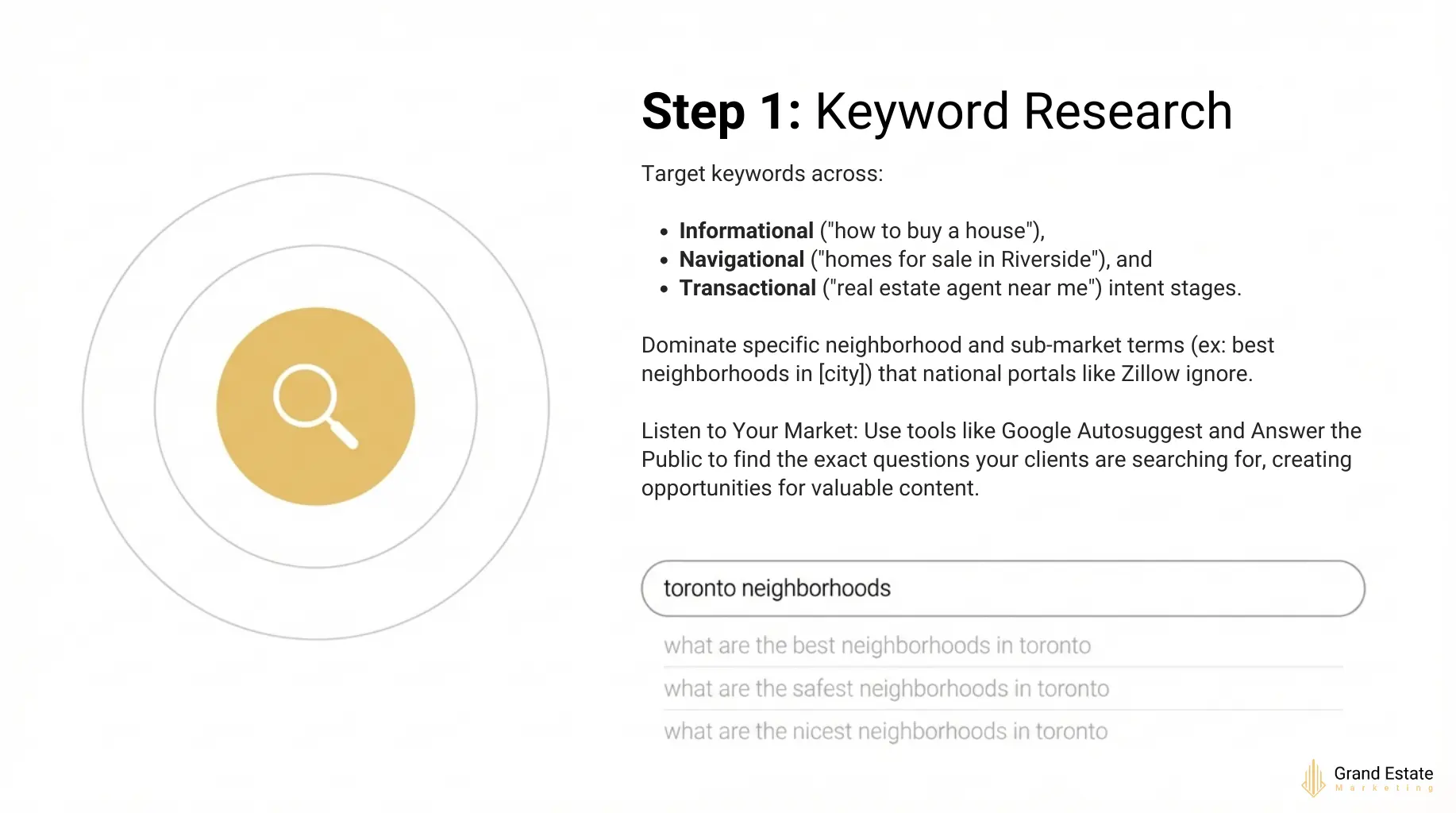
Organize your keyword research into different buyer journey stages:
- Informational keywords attract people in the early research phase. Examples include "how to buy a house with bad credit" or "what is a good school district in Phoenix." These searchers aren't ready to hire you yet, but you're building trust and awareness.
- Navigational keywords include branded searches and location-specific queries like "homes for sale in Riverside" or "luxury condos Miami Beach." These indicate stronger intent.
- Transactional keywords signal immediate action. Think "real estate agent near me" or "schedule home showing Portland." These are your money keywords, but they're also the most competitive.
The Hyperlocal Advantage
Generic terms like "homes for sale in [major city]" have massive search volumes but they're nearly impossible to rank for, because they're constantly dominated by Zillow, Realtor, etc.
Instead, focus on hyperlocal keywords that match your actual service area:
- [Neighborhood name] homes for sale
- Real estate agent in [specific city/neighborhood]
- [City] real estate market trends
- Best neighborhoods in [city] for families
- [Neighborhood] property values
You can dominate these hyperlocal terms because they have less competition and you have genuine local expertise that major websites don't cover (they prioritize high competition keywords).
Tools That Actually Help
A good way to start is to use Google's own auto suggest feature and the frequently asked questions in the search results.
Answer the Public reveals the actual questions people are asking about real estate in your market. These question-based queries make excellent blog topics and FAQ content.
We also love using the free version of Ahrefs SEO Tools, which provide you a lot of useful data on keyword ideas, search result analysis, website traffic, backlinks, etc.
You can upgrade to their paid plans for a much detailed data, but we only recommend their paid plans if you know what you're doing and not waste your credits. Their free SEO courses are among the best in the industry (even better than $1000 courses).
Your own Google Search Console data also shows which terms already drive traffic to your site. Look for keywords where you rank on page two (or bottom of page one), these are opportunities where small improvements can generate significant results. This only works if you already have GSC connected and has been collecting data for at least few weeks or even months to see useful data.
Step 2: On-Page SEO
Once you know which keywords to target, you need to optimize your website pages to rank for them. On-page SEO is where many real estate websites fail despite having decent content.
Title Tags and Meta Descriptions
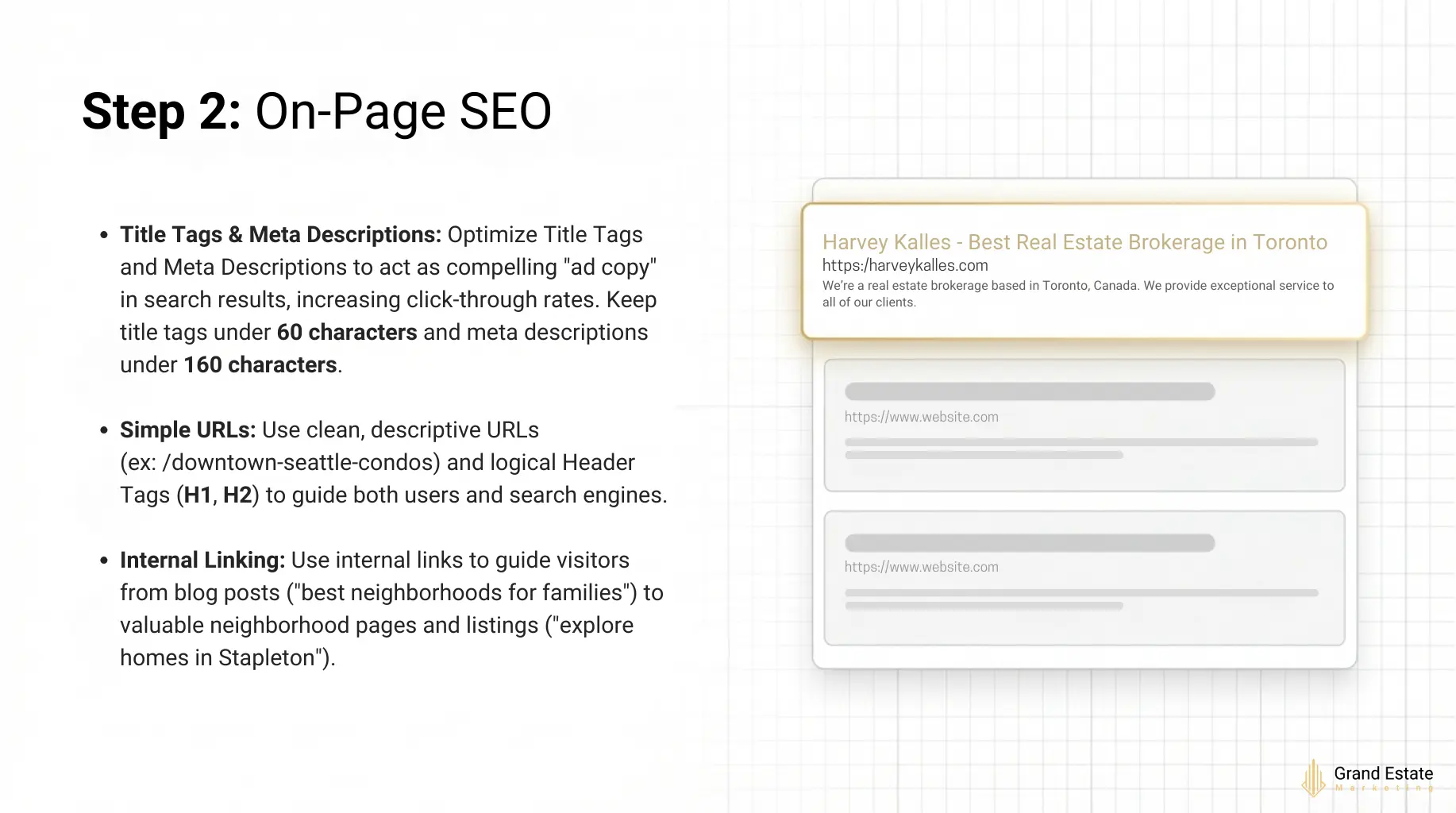
Your title tag is the single most important on-page SEO element. It should include your target keyword naturally while remaining compelling to human readers.
Weak example: "Home Page - John Smith Real Estate"
Strong example: "Austin Real Estate Agent | Homes for Sale in Travis County | John Smith"
Meta descriptions don't directly impact rankings, but they dramatically affect click-through rates. Write them like ad copy that entices searchers to choose your result over competitors.
Keep title tags under 60 characters and meta descriptions under 160 characters so they don't get cut off in search results.
URL Structure
Clean, descriptive URLs help both users and search engines understand your content.
Poor structure: yoursite.com/page?id=12345
Better structure: yoursite.com/downtown-seattle-condos-for-sale
Include your target keyword in the URL when possible, but keep it concise and readable.
Important: Make sure to set up URL re-directs from old URLs to the updated ones. This makes sure the authority of your pages passes to the newer ones, and it prevents the 404 page error. Not doing this will be detrimental to your website SEO rankings.
Header Tags and Content Organization
Use H1 tags for your main page title, and include your primary keyword there. Then use H2 and H3 tags to organize your content into logical sections.
This hierarchy helps Google understand your content structure while making your pages more scannable for visitors. Remember, most people skim online content rather than reading every word.
Internal Linking
Many real estate websites are essentially collections of isolated pages with no strategic connections between them. This is a massive missed opportunity.
Link from your high-authority pages (like your homepage or popular blog posts) to important pages you want to rank. Use descriptive anchor text that includes relevant keywords.
For example, when writing a blog post about "best neighborhoods for families in Denver," naturally link to your neighborhood pages and relevant property listings using phrases like "explore homes in Stapleton" rather than generic "click here" text.
Image Optimization
Real estate sites are inherently image-heavy, which creates both an opportunity and a potential problem.
Compress your images before uploading them. A 3MB photo might look stunning, but it will destroy your page load speed. Tools like TinyPNG can reduce file sizes by 70% without visible quality loss. You can use Photopea for more control over the export of your images.
Use descriptive file names that include relevant keywords: "modern-kitchen-downtown-austin-condo.jpg" instead of "IMG_4782.jpg."
Additionally, if your website platform supports it, save your images as a .webp file, its a more modern version of jpg and png combined into a single format for the web. It a much more efficient format without impacting quality.
Fill out alt text for every image. This helps visually impaired users and gives Google context about your images. Alt text like "spacious master bedroom with hardwood floors in Westlake Hills home" is far better than leaving it blank or using "bedroom photo."
Step 3: Technical SEO
Technical SEO might sound intimidating, but ignoring it may not give you the most optimal results. Its not very complicated, really.
Mobile Optimization
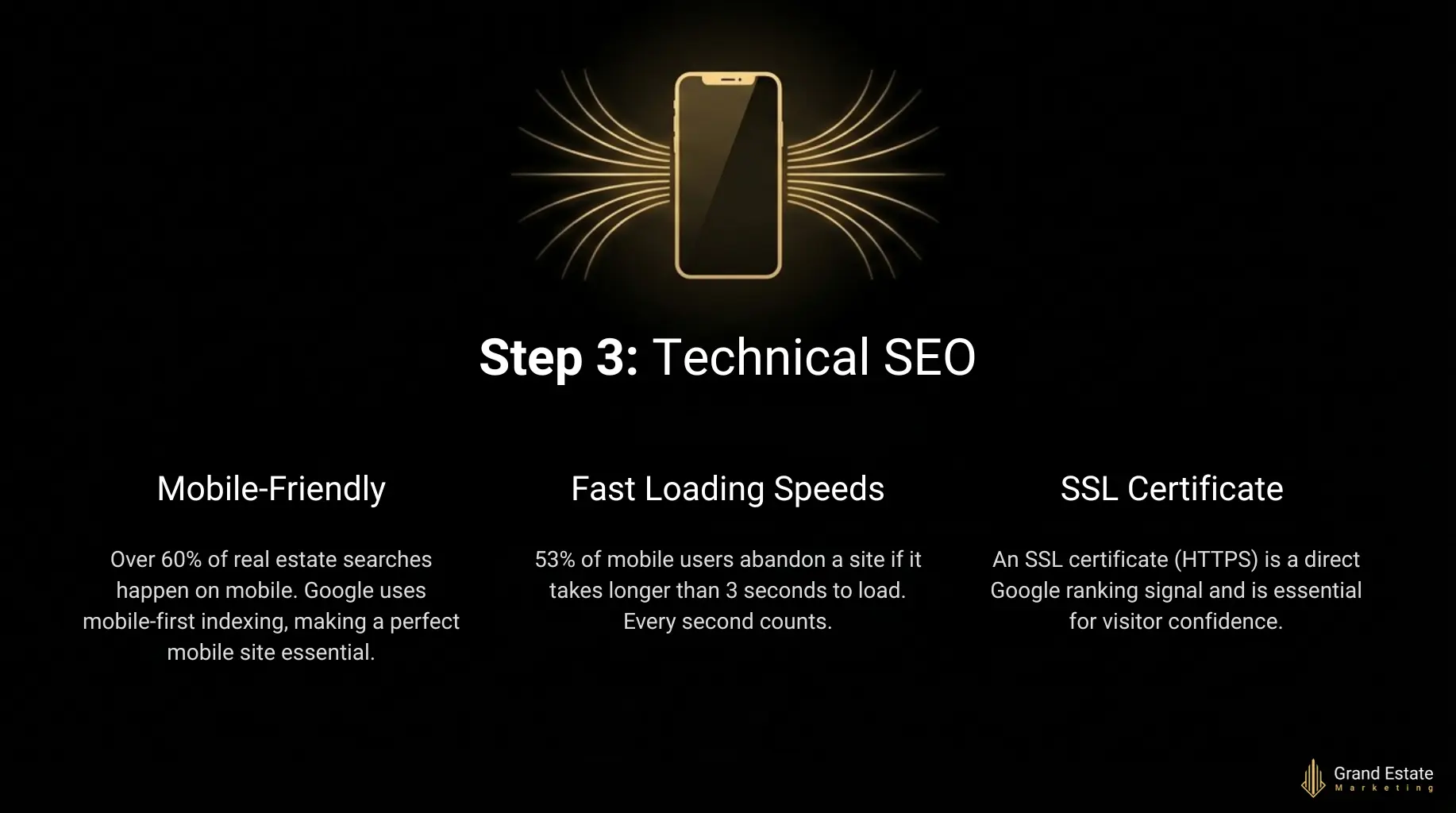
Over 60% of real estate searches happen on mobile devices. If your site doesn't work flawlessly on phones and tablets, you're losing the majority of potential clients.
Google uses mobile-first indexing, meaning it primarily looks at the mobile version of your site when determining rankings. Test your site using Google's Mobile-Friendly Test tool and fix any issues immediately.
Common mobile problems include:
- Text that's too small to read without zooming
- Buttons and links too close together to tap accurately
- Horizontal scrolling required to see content
- Pop-ups that cover the entire screen with no easy way to close them
Site Speed
Every second of load time costs you leads. Studies show that 53% of mobile users abandon sites that take longer than three seconds to load.
Run your site through Google PageSpeed Insights to identify specific issues slowing you down. Common culprits include:
- Oversized images (as mentioned earlier),
- Too many plugins or scripts
- Lack of browser caching
- Slow server response time.
Consider using a content delivery network (CDN) to serve your images and static files faster. Many real estate websites see dramatic speed improvements just from implementing a CDN. Many reputable hosting providers already support this.
SSL Certificate
HTTPS isn't optional anymore. Google explicitly uses HTTPS as a ranking signal, and browsers now display scary warnings for sites without SSL certificates.
Almost all hosting providers have SSL certificates. If your site still uses HTTP, migrate to HTTPS immediately.
XML Sitemap
Your XML sitemap tells search engines which pages exist on your site and how they're organized. Submit your sitemap through Google Search Console so Google can crawl and index your content efficiently.
For real estate sites with hundreds or thousands of property listings, make sure your sitemap includes all active listings while excluding expired ones.
Schema Markup
Schema markup is code that helps search engines understand the context of your content. For real estate, implementing proper schema can get you enhanced search results.
Key schema types for real estate include:
- LocalBusiness schema for your agency information
- RealEstateAgent schema for agent profiles
- Product or Offer schema for individual property listings
- Review schema to display star ratings
You don't need to be a developer to implement schema. Tools like Schema Markup Generator make it relatively straightforward.
Step 4: Local SEO
Local SEO deserves special attention in your real estate SEO strategy because real estate is fundamentally a local business. Someone in Dallas doesn't care about the best agent in Denver.
Google Business Profile Optimization
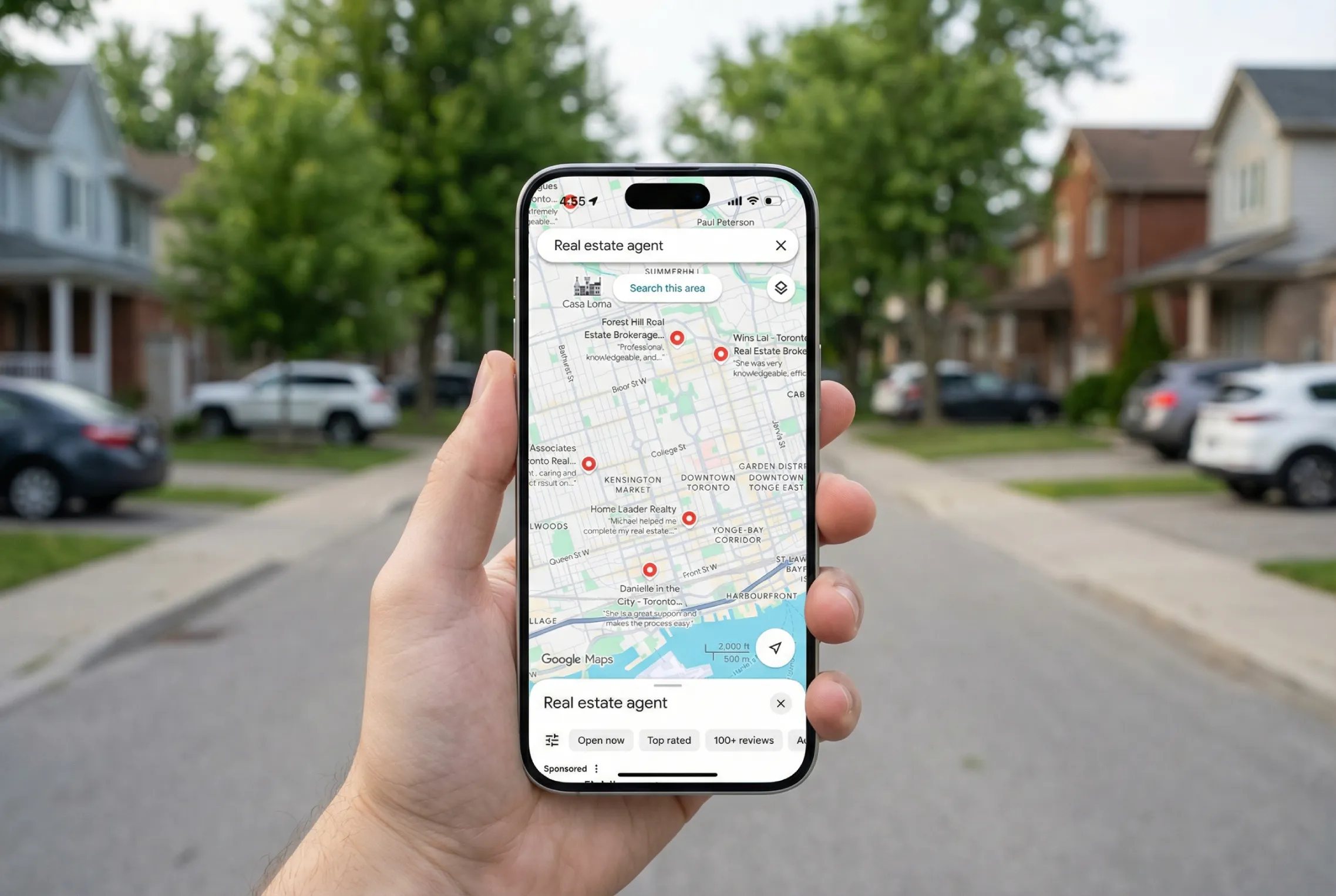
Your Google Business Profile (formerly Google My Business) is the single most important element of local SEO. When someone searches "real estate agent near me," Google primarily pulls results from Business Profiles.
- Complete every section of your profile. Add your business description, services, hours, photos, and attributes. Profiles with complete information rank significantly higher.
- Choose the right categories. Your primary category should be "Real estate agency" or "Real estate agent." Add secondary categories like "Real estate appraiser" or "Property management company" only if you actually offer those services.
- Upload high-quality photos regularly. Profiles with photos get 42% more requests for directions and 35% more clicks to their websites. Include photos of your team, office, local landmarks, and properties you've sold.
- Collect and respond to reviews consistently. Reviews are a major ranking factor for local search. More importantly, they influence whether potential clients actually contact you.
Create a systematic process for requesting reviews from satisfied clients. Send a follow-up email after closing with a direct link to your Google Business Profile review page.
Respond to every review, both positive and negative. Thank people for positive reviews with personalized responses. Address negative reviews professionally, acknowledging concerns and offering to resolve issues offline.
NAP Consistency
NAP stands for Name, Address, and Phone number. Google uses NAP consistency across the web to verify that your business is legitimate and to determine your location relevance.
Your NAP must be identical everywhere it appears:
- Your website
- Google Business Profile
- Social media profiles
- Directory listings
- Your email signature
Even small variations ("Street" vs. "St." or including/excluding suite numbers) can confuse Google and dilute your local SEO efforts.
Local Citations and Directory Listings
Citations are online mentions of your business name, address, and phone number. They help Google verify your business legitimacy and improve local rankings.
Focus on quality over quantity. Start with major platforms:
- Zillow
- Realtor.com
- Yelp
- Better Business Bureau
- Local chamber of commerce
Then expand to industry-specific directories and local business listings relevant to your market.
Claim your profiles on these platforms rather than letting them be auto-generated with potentially incorrect information. Fill out profiles completely and keep information current.
Creating Location-Specific Pages
If you serve multiple cities or neighborhoods, create dedicated pages for each location. Don't just duplicate content and swap out place names, that's thin content that Google will penalize.
Each location page should include:
- Unique, substantial content about that specific area
- Local market statistics and trends
- Featured properties in that neighborhood
- Testimonials from clients in that area
- Embedded Google map centered on the location
- Links to relevant neighborhood guide content
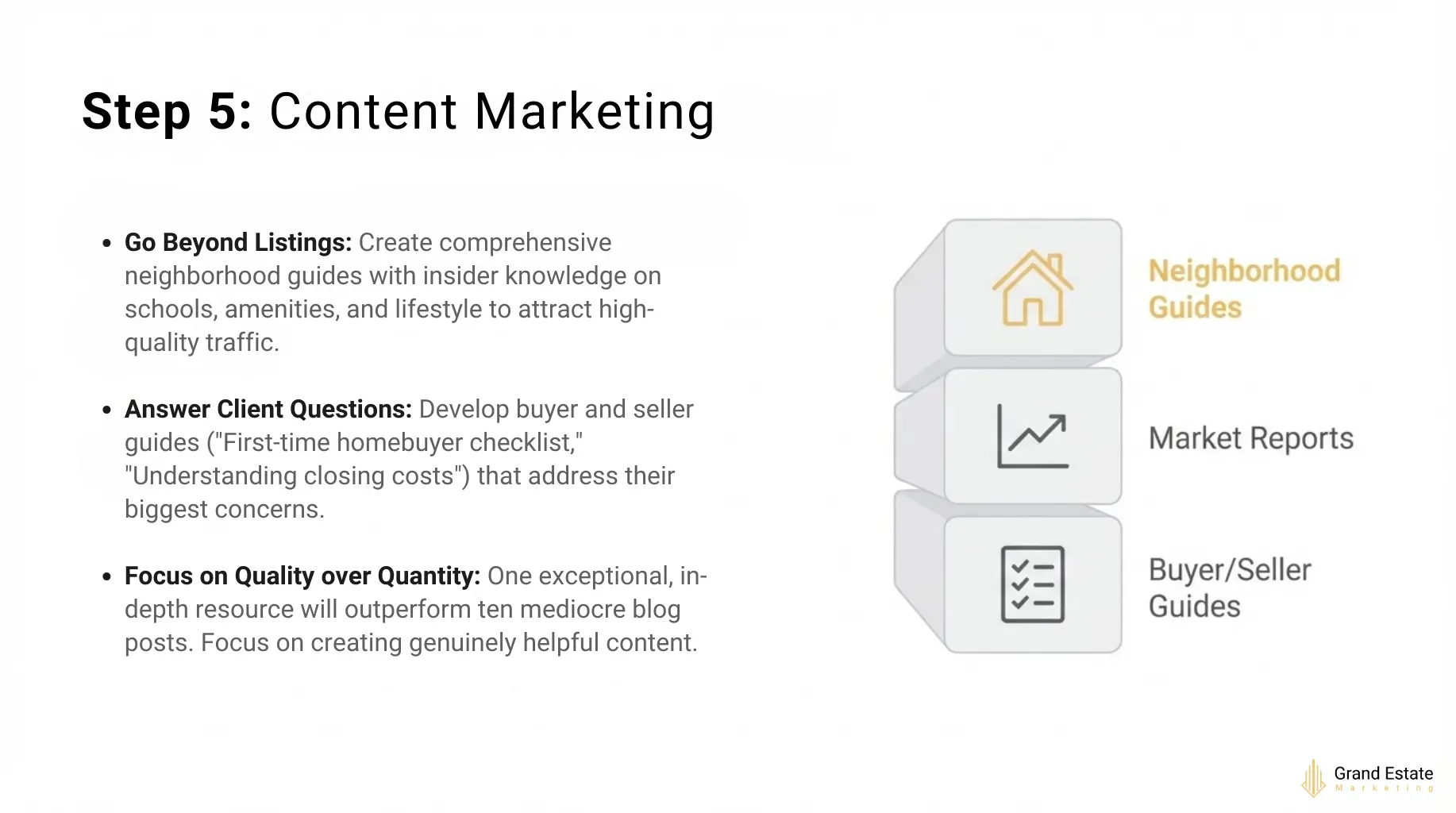
Step 5: Content Marketing
Content marketing isn't about churning out blog posts for the sake of it. Your real estate SEO strategy needs content that genuinely helps your target audience while strategically targeting valuable keywords.
The Types of Content That Actually Work
- Neighborhood guides consistently drive high-quality traffic and backlinks. Create comprehensive resources covering local amenities, schools, demographics, average home prices, and lifestyle factors.
Don't just list facts. Share insider knowledge about which streets are quieter, which parks are best for different age groups, or where locals grab coffee on Saturday mornings. This depth separates you from generic real estate portals.
- Market reports and data establish you as an authority. Publish quarterly market updates with trends, statistics, and your expert analysis. These attract links from local media and other websites citing your data.
- Buyer and seller guides target those crucial informational keywords while nurturing potential clients through their journey. Cover topics like:
- First-time homebuyer checklist
- How to prepare your home for sale
- Understanding closing costs
- Negotiation strategies for buyers
- What to expect during the home inspection
- Comparison content helps people make decisions while targeting multiple keywords. Examples include comparing neighborhoods, condo vs. house ownership, different mortgage types, or working with a realtor vs. FSBO.
The Publishing Consistency Myth
You've probably heard that you need to publish new content constantly to succeed with SEO. That's not entirely true, especially for real estate.
Quality and strategic focus matter far more than publishing frequency. One exceptional, comprehensive guide that targets the right keywords and genuinely helps your audience will outperform ten mediocre posts rushed out to meet an arbitrary schedule.
That said, fresh content does matter. Aim for a sustainable publishing schedule, whether that's twice a month or once a week—that you can actually maintain while ensuring quality.
Updating Existing Content
Many real estate agents ignore their older content, but updating existing pages and posts can deliver quick SEO wins.
Review your content quarterly and:
- Update statistics and market data to keep information current
- Add new sections covering recent developments or commonly asked questions
- Improve internal linking to newer relevant content
- Enhance images and add new visuals
- Expand thin content that doesn't comprehensively cover its topic
Google rewards freshness, especially for topics where recency matters. A "2023 Austin Real Estate Market Guide" needs to become a "2026" guide to maintain its relevance and rankings (don't include year in the URL).
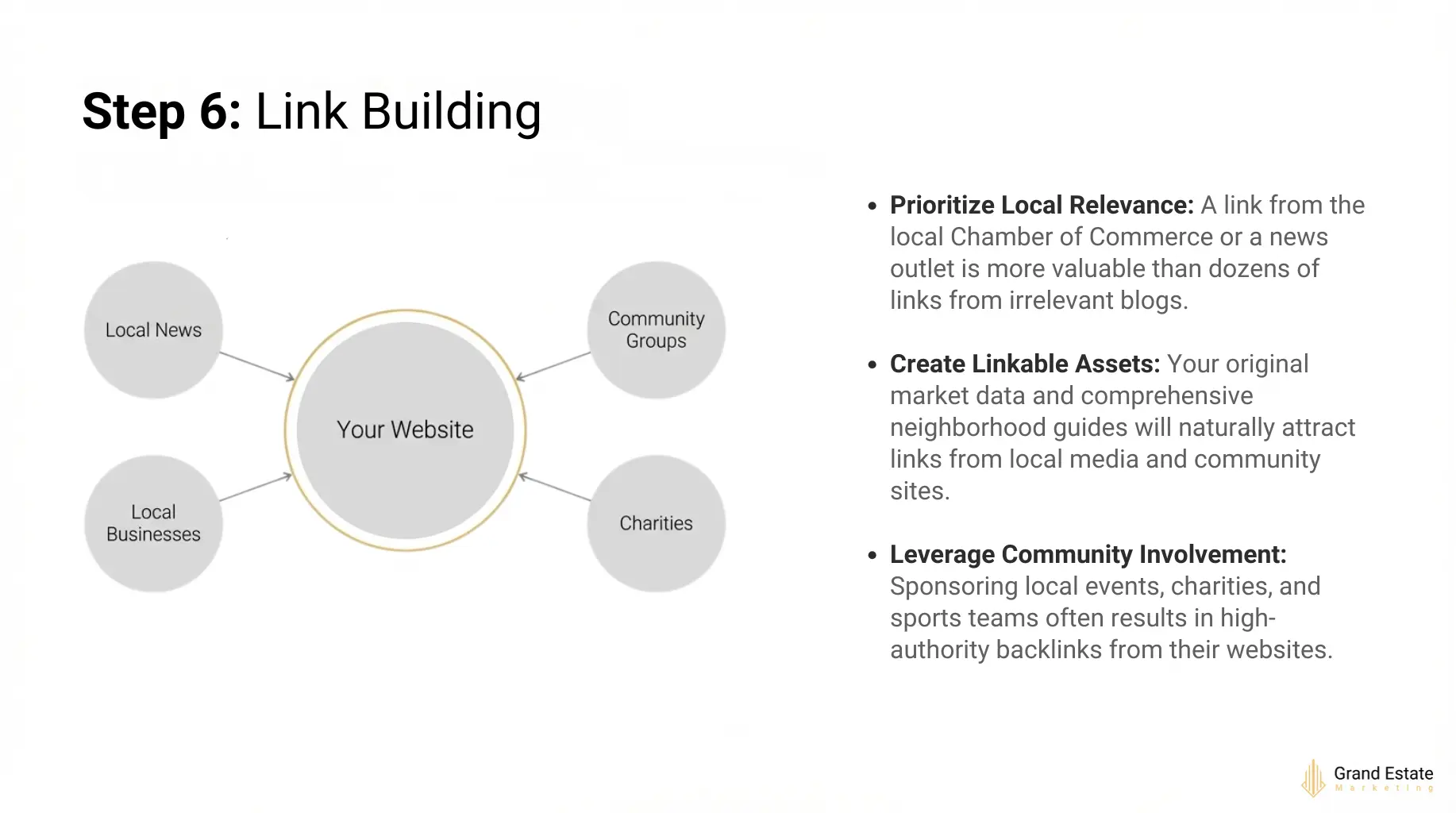
Step 6: Link Building
Backlinks are links from other websites pointing to yours, and they're one of Google's most important ranking factors. But link building in real estate requires a different approach than most industries.
The Links That Actually Matter
Not all backlinks are created equal. One link from a major local news site is worth more than dozens of links from random directories or irrelevant blogs.
- Prioritize local relevance. Links from local news outlets, community organizations, school websites, and city government pages carry significant weight for local SEO.
- Focus on editorial links. These are links that websites give you because your content is genuinely valuable, not because you paid for them or exchanged links. Editorial links are the gold standard.
- Avoid link schemes. Buying links, participating in link exchanges, or using private blog networks will get you penalized. Google has become remarkably good at detecting these tactics.
Strategies That Work for Real Estate
- Create genuinely linkable content. Your comprehensive neighborhood guides, original market research, and useful resources naturally attract links when other sites reference them.
- Publish local market statistics and analysis that local media outlets might cite in their stories. Reach out to journalists covering real estate or local news in your area when you have relevant data or expertise to share.
- Community involvement translates to links. Sponsor local events, youth sports teams, or charity initiatives. Many of these organizations will link to sponsors from their websites.
- Join local business associations and chambers of commerce. Most include member directories with website links.
- Guest contribute to local publications. Many local news sites, community blogs, and business publications accept guest articles from local experts. Write something genuinely useful for their audience and you'll typically get an author bio link back to your site.
- Leverage your past clients. If you've helped clients who run local businesses, they may be happy to feature a testimonial about their home buying experience on their business website with a link back to you.
- Host or participate in local events. Homebuyer seminars, first-time buyer workshops, or market trend presentations at local libraries or community centers often result in links from event calendars and promotional pages.
Monitoring Your Backlink Profile
Use Google Search Console to monitor which sites link to you. This helps you identify valuable links to potentially replicate and toxic links to disavow.
If you notice suspicious links from spammy sites pointing to your pages, use Google's Disavow Tool to tell Google to ignore them. This protects you from negative SEO attacks or old link building tactics that may now be harmful.
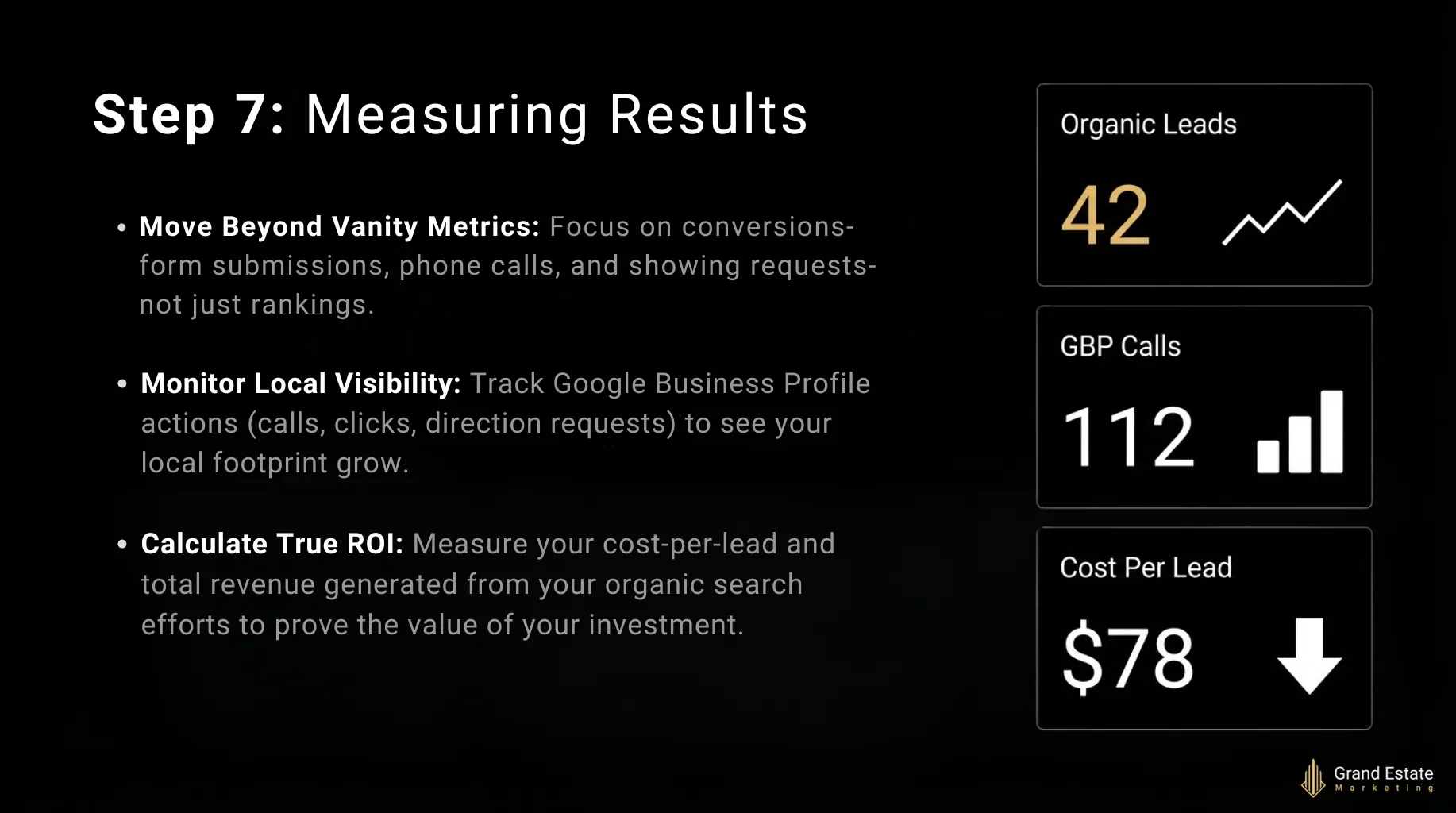
Step 7: Measuring Results
Your real estate SEO strategy needs clear metrics to determine what's working and what needs adjustment.
Organic Traffic
Track your overall organic traffic trends in Google Analytics. Look beyond the top-line number and segment by:
- Landing pages to see which content drives traffic
- Geographic location to understand where your visitors come from
- Device type to ensure mobile traffic is growing
- New vs. returning visitors to gauge awareness vs. engagement
Keyword Rankings
Monitor your rankings for target keywords, but don't obsess over daily fluctuations. Track weekly or monthly trends instead.
Focus on your priority keywords—the ones that actually drive qualified leads. Ranking #1 for a keyword that doesn't generate conversions is meaningless.
Conversion Metrics
Traffic means nothing if it doesn't generate leads. Track:
- Form submissions (contact forms, property inquiries, etc.)
- Phone calls from organic search visitors
- Email newsletter signups
- Property showing requests
Set up conversion tracking in Google Analytics so you can see which content and traffic sources actually produce leads.
Local Visibility
For local SEO, track:
- Google Business Profile views and actions (calls, direction requests, website visits)
- Local pack rankings for city-specific searches
- Review quantity and average rating over time
ROI Calculation
Calculate the actual return on your SEO investment by tracking:
- Cost per lead from organic search vs. paid advertising
- Close rate of leads from organic search
- Average commission from clients acquired through organic search
- Total revenue attributed to SEO efforts
This data helps you justify continued investment in your real estate SEO strategy and identify areas for improvement.
Common Real Estate SEO Mistakes to Avoid
Even experienced agents make critical SEO mistakes that undermine their efforts.
Duplicate Content
Many real estate websites pull property descriptions directly from MLS feeds, creating duplicate content across thousands of sites. This gives you zero chance of ranking for those properties.
Add unique content to listing pages. Include your personal insights about the property, neighborhood commentary, and why specific features matter. Even a few paragraphs of original content makes a difference.
Ignoring Blog Content After Publishing
Publishing a blog post and never touching it again wastes its potential. Regularly update posts with fresh information, additional sections, and improved internal linking.
Focusing Only on Rankings
Rankings are a vanity metric if they don't drive business results. An agent ranking #1 for "luxury mansions in Beverly Hills" but serving only first-time buyers in Pasadena has misaligned their strategy.
Neglecting User Experience
Flashy designs with auto-playing videos, aggressive pop-ups, and confusing navigation might look impressive in screenshots, but they drive visitors away before they convert.
Test your site with fresh eyes. Better yet, have someone unfamiliar with it try to complete common tasks like finding your contact information or searching for properties in a specific neighborhood.
Trying to Rank for Everything
Spreading your efforts too thin across too many keywords dilutes your impact. Especially when starting out, focus on dominating a smaller set of realistic targets rather than chasing every possible keyword.
Expecting Instant Results
SEO is a long-term strategy. You won't rank #1 next week, and anyone promising that is lying. Most real estate markets take 6-12 months of consistent effort before you see significant results.
However, once you do start ranking well, those positions tend to be relatively stable and continue generating leads with minimal ongoing effort.
Putting Your Real Estate SEO Strategy Into Action
Now you understand the components of effective real estate SEO. Here's how to actually implement this knowledge:
Phase 1: Foundation (Month 1)
Fix technical issues first. Ensure your site is mobile-friendly, fast, secure, and properly structured. Without a solid foundation, your content efforts won't deliver full results.
Complete your keyword research and identify your priority targets. Focus on hyperlocal terms where you have a realistic chance of ranking.
Optimize your existing pages with proper title tags, meta descriptions, headers, and internal linking.
Set up and fully optimize your Google Business Profile.
Phase 2: Content Development (Month 2-4)
Create comprehensive neighborhood guides for your primary service areas. These should be substantial resources, not thin pages with a few paragraphs.
Develop buyer and seller guides targeting key informational keywords.
Start a consistent blog schedule covering questions your clients actually ask.
Phase 3: Authority Building (Month 4-6)
Begin your link building efforts through community involvement, local PR, and creating shareable content.
Focus on building NAP consistency across major directories and platforms.
Implement a review generation system to consistently grow your Google Business Profile rating.
Phase 4: Optimization and Expansion (Month 6+)
Analyze your results to identify what's working. Double down on successful content types and keywords.
Update and improve existing content based on performance data.
Expand to additional locations or keywords as you gain traction with your initial targets.
Continue link building and relationship development in your local community.
The Bottom Line
SEO isn't a magic bullet that generates leads overnight, but it's one of the most powerful long-term investments you can make in your real estate business. Unlike paid advertising that stops working the moment you stop paying, your real estate SEO strategy continues delivering results for months or years after you do the work.
The agents who win in the coming years will be those who start building their organic presence now. Your future self will thank you for the leads that come in effortlessly because you laid this groundwork today.
Start with the basics, stay consistent, and focus on creating genuinely useful content for your target audience. The rankings and leads will follow.
Need Help Implementing Your Real Estate SEO Strategy?
Building and executing a comprehensive real estate SEO strategy takes time, expertise, and consistent effort. If you're feeling overwhelmed by everything covered in this guide, you're not alone. Most successful real estate agents partner with marketing specialists who handle the technical details while they focus on what they do best: selling homes and serving clients.
Our real estate marketing company specializes in helping agents and brokerages with their local markets through proven SEO strategies.
We're offering free consultations where we'll review your current website, identify quick wins you can implement immediately, and outline a customized strategy tailored to your specific market and goals.
There's no obligation and no pressure. Just honest feedback from people who live and breathe real estate marketing every day.